BEAUFORT — The story of the first Thanksgiving in North America nearly perfectly embodies the truism that history is written by the victors.
Representations of the “first” Thanksgiving are rife with English pilgrims and Native Americans celebrating a bountiful harvest in Plymouth, Mass., in the fall of 1621. That’s all true enough.
But according to historical records, the French may have celebrated a Thanksgiving some 57 years earlier and 1,000 miles south of New England. And while that took place in somewhere along the St. John’s River near present-day Jacksonville, Fla., there is a direct line between events on Beaufort County’s Parris Island and that celebration.
In the middle of the 16th century, the seemingly endless resources of the New World were up for grabs among the powerful western Europe nations, who paid little heed to the fact that the New World was already inhabited by indigenous people. Spain and France were the early leaders in the race for dominance in what would eventually become the United States. England was relatively late to the game, not making its first attempt until 1585.
Two decades earlier, France, intent on getting a foothold in the New World, dispatched naval officer Jean Ribaut with orders to establish a colony along the coast.
An attempt to settle on Parris Island
Ribaut sailed from France in 1562 with a pair of ships and 150 men. He first scouted the northeast coast of Florida before heading north into the Port Royal Sound. The French landed on what is now Parris Island in mid-May of the same year and built Charlesfort, named for King Charles IX.
Besides being an excellent natural harbor, Port Royal would also provide the French easy access to the Spanish treasure ships sailing home from Peru and Mexico heavily laden with silver and gold.
“Port Royal and Parris Island would be great launching place for the corsairs to attack the treasure fleets and steal the treasure. The Spanish were very upset when they learned the French were in the area for that reason,” said Karen Paar, professor at Mars Hill University.
Staying for less than a month, Ribaut left a contingent of 28 volunteers on the island and sailed back to France with a promise to return with supplies in six months.
His plan was derailed by religious civil war in France, which pitted the Protestant Huguenots against Catholics. When the promised resupply failed to appear, the situation at Charlesfort devolved. Food shortages, infighting and conflicts with local Native American tribes led to the fort’s abandonment within a year of their arrival, according to authors Lawrence S. Rowland, Alexander Moore and George C. Rogers in “The History of Beaufort County, South Carolina – Volume 1, 1514-1861.”
If that story sounds familiar, it follows essentially the same lines as the Lost Colony of Roanoke. Founded by the English in 1587, it also suffered when hoped-for supplies from England never materialized. The settlement was found deserted when supply ships did finally arrive three years later, setting off more than 400 years of speculation about what became of those colonists.
Unlike the English colonists, the fate of the French from Charlesfort is known — though it isn’t pretty.
Following a mutiny and the murder of the fort’s commanding officer, the remaining men abandoned the island in April 1564, intent on making the 3,000-mile trip across the Atlantic to France in an open boat. The staggering challenge led to misery and, reportedly, cannibalism before they were rescued by an English ship.
The Spanish, upon learning of Charlesfort, sailed from Cuba with a plan to decimate the settlement. Instead, they discovered an abandoned fort at Parris Island. Spanish troops burned what remained and left, though they would return two years later to establish Santa Elena near the same site.

Santa Elena first appeared on a Spanish map in 1530. It was located on what is now Parris Island in Beaufort County. The site had been home to Charlesfort, a short-lived French settlement.
Une fête célébrée Thanksgiving
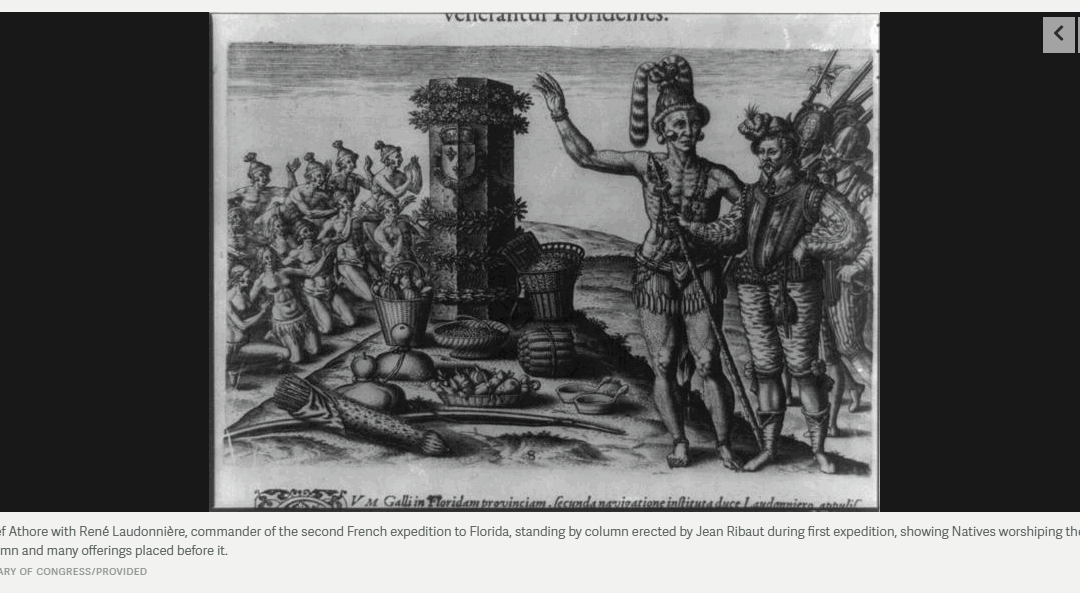
With the stinging failure of Charlesfort still fresh in their minds, the French made a second attempt to establish a colony in 1564. René de Laudonnière — who had been Ribault’s second in charge — landed at the mouth of the St. John’s River with his contingent of 300 soldiers, establishing Fort Caroline near present-day Jacksonville.
On June 30, 1564, Laudonnière and his Huguenot companions gathered on the beach and celebrated a day of thanks for their safe journey. It may have been the first Thanksgiving celebrated in the New World.
“On that day on the beach, I commanded us to sing aloud (like a trumpet), to ends that we assembled render thanks to God, of our arrival felicitous and happy,” he wrote in his journal of the event.
The good feelings were short lived. Ultimately, Fort Caroline fared only marginally better than Charlesfort.

Charlesfort monument near the Santa Elena site at the Marine Corps Recruit Depot on Parris Island.
The Spanish, incensed that the Protestant Huguenots were moving into territory they believed belonged to Spain, made plans to lay waste to Fort Caroline. In 1565, Pedro Menéndez de Avilés set sail for Florida intent on achieving that goal. About the same time, Ribaut was sailing from France to reinforce Fort Caroline. The two opposing forces raced across the Atlantic, with the fate of Fort Caroline hanging in the balance.
Ribaut arrived first and anchored his fleet in the St. John’s River. Menéndez landed a bit further south near what would become St. Augustine.
Learning of Menéndez’s arrival, Ribaut loaded most of his fighting men onto ships and planned to attack the Spanish. Bad luck intervened in the form of a hurricane that dashed all four French ships along the coast south of St. Augustine. Meanwhile, Menéndez launched a ground attack on the lightly defended Fort Caroline in September 1565. He showed no mercy, killing 132 men and capturing the women and children.
Menéndez then marched his troops south to intercept Ribaut’s scattered forces. In “The Spanish Frontier in North America,” author David J. Weber described the battered French negotiating their surrender in exchange for their lives being spared. Menéndez promised that he would deal with the prisoners “as Our Lord should command me.”
With the prisoners’ hands tied behind their backs, Menéndez put approximately 250 Frenchmen to death, including Ribaut.
The rise of the English
There are some number of claims for the first Thanksgiving that predate the celebration in the Plymouth Colony by decades, though none captured the imagination of the Americans more than the story from 1621.
“The bloodshed helped to wash away historical memory of the thanksgiving ceremonies held by both the French and Spanish settlers in the 1560s until their rediscovery in recent decades,” suggested Christopher Klein in an article on History.com.
The English weren’t much of a presence in the New World in the 16th century. But by the 17th century, they became the dominant power, establishing 13 colonies along the Atlantic Coast. Today, it’s their story that prevails in the Thanksgiving ethos.
–postandcourier.com