SOUTH CAROLINA: A hidden treasure was buried in Charleston decades ago. A Summerville man thinks he’s found it
MOUNT PLEASANT — For over 40 years, a 19-line poem has intrigued treasure hunters.
The prose, and a corresponding painting, is one of 12 riddles compiled in “The Secret: A treasure,” a book by Byron Preiss. The author buried a dozen casques around the country for armchair treasure hunters to find.
Yet for those four decades, nine of those casques have remained underground, including the one Preiss buried somewhere in Charleston. The Lowcountry treasure’s true resting place has eluded determined treasure seekers, leading them to several area landmarks throughout the years.
A lion’s head dominates the painting. Two masks feature a hidden map of the Charleston Harbor and an aerial view of Fort Sumter. A water fairy anchors the image, with a pear and flower near her.
An image from the pictorial guide “The Secret: A Treasure Hunt,” displays clues such as the outlines of a map on the forehead of the mask that suggest Charleston as a location for a buried vase.
In 2019, the cast of Discovery Channel’s show “Expedition Unknown” believed these visual cues meant Preiss had buried his treasure in White Point Gardens. The paintings have led others to Fort Sumter. Fort Moultrie is another popular guess thrown about.
To date, no one has been successful.
But a Summerville man believes he has determined the treasure’s exact location, give or take a few feet.
After years of twists and turns, dead ends and rabbit hole theories, Chris Enfinger is certain he has solved the puzzle. His search has led him to a patch of grass in Mount Pleasant, in the shadow of the U.S.S. Yorktown.
Enfinger has spent countless hours picking apart Preiss’s words and analyzing the corresponding painting.
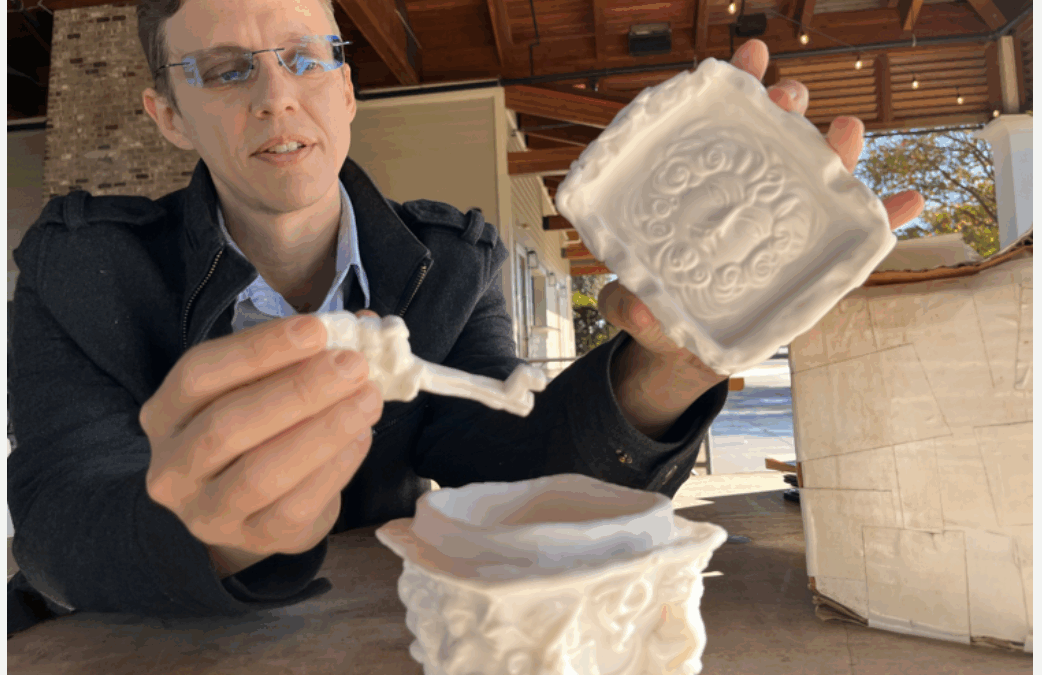
He’s got a first edition copy of “The Secret,” an annotated version, and another still in Japanese. He has a 3D-printed recreation of one of the casques and the key inside. He also is now well-versed in Robert Louis Stevenson’s “Treasure Island,” a prerequisite for solving Charleston’s puzzle.
A 3D-printed replica of one of Byron Preiss’s 12 casques buried throughout the country.Anna Sharpe/Staff
The one crucial thing he doesn’t have is the go-ahead to dig.
Unlike Nicholas Cage in “National Treasure” or John B. and his band of Pogues in “Outer Banks,” Enfinger is not prepared to skirt the law for treasure’s sake.
“Treasure” is a strong word for what’s really buried there, Enfinger admits.
It’s actually a plexiglass box containing a ceramic casque with a skeleton key inside. The boxes are buried no more than three feet underground.
Once discovered, the finder was meant to mail the key to Preiss. In return, Preiss would mail back a jewel, worth around $1,000, to the successful hunter.
Preiss had another offer for faithful treasure seekers, too.
If the treasure was buried on private property, or in a place where legal troubles could arise from attempting to retrieve it, Preiss would come and dig it up himself. He’d gladly bear the potential consequences.
But Preiss died in a car accident in 2005. At the time of his death, only two of the 12 treasures had been found, in Chicago and Cleveland. A casque in Boston was located in 2019.
Preiss’s surviving family has agreed to pass along the gemstones, but they’re not as willing to break the law for the treasure seekers as Preiss was.
Enfinger shares this sentiment, though his attempts to get permission from Patriots Point to dig have been less than fruitful.
He’s emailed, called and even offered a blank check to the museum in exchange for the opportunity to probe the ground, all to no avail.
He’s not the first treasure seeker to run into red tape.
Charleston security guard James Vachowski was certain he’d cracked the riddle in 2017. He detailed his solution and thought process in a lengthy blog post on his website he still maintains today.
He believed it was next to Osceola’s grave at Fort Moultrie on Sullivan’s Island. He couldn’t get permission from the National Park Service to excavate the site. Doing so, an NPS spokesperson said at the time, would be a crime.
“To dig or conduct a search for it on federal land would violate several laws,” a Park Service spokeswoman told The Post and Courier in 2018. “The area mentioned is also a location within a federal area where human remains are buried. It is literally both an archaeological site and a graveyard.”
Patriots Point did not respond to questions about the museum’s policy on private excavations.
Even if Enfinger never got the chance to truly see if his assumptions are correct, for him, the puzzle is solved. But for other hunters who may not be as satisfied, he said hopes he can eventually prove he’s right.
“Part of me wants it to be found,” Enfinger said. “When I think about how much time people might be spending looking for it … finding it would be a relief to them, to go spend their time doing other things.”
VIRGINIA: Divorce becomes next battleground as Virginia, other states debate family values Cerina Fairfax, a Virginia dentist and mother of two, spent nearly two years living in the same house Read More