SOUTH CAROLINA: Charleston historian uncovers date SC flag was first flown. It’s not the design we know today.
A Charleston historian has uncovered brand new information about the first recorded appearance of South Carolina’s signature crescent flag.
But he had to go to England to find it.
Nic Butler, a historian for the Charleston County Public Library and host of the Charleston Time Machine, this summer reviewed archival Royal Navy logbooks tied to ships stationed in Charleston Harbor in the early days of the American Revolution.
He came across two unexpected observations that a pair British naval officers recorded in 1775.
Lieutenant John Fergusson and Master William Pickard served on the Cherokee, an armed ship intended for a surveying expedition. The men recorded the events of each day in their logbooks, as was expected of the king’s officers.
On Nov. 22, 1775, Fergusson and Pickard described “light breezes and fair weather” in the harbor. That morning they wrote, the “Rebels at Fort Johnson hoisted their Provincial Colours, a White Crescent in a Green Field.”
The entry was enough to make Butler, who spends his vacation days in archive rooms and libraries, pause — for two reasons.
“It was totally unexpected,” Butler said. “That’s the earliest reference I’ve seen with the flag. That must be the day that the flag debuted. Oh, but wait a minute — it’s green.”
Many historians believe the flag to have appeared in late 1775 to early 1776, but Butler said the logs from Fergusson and Pickard provide definitive confirmation of the South Carolina flag’s earliest appearance, in November.
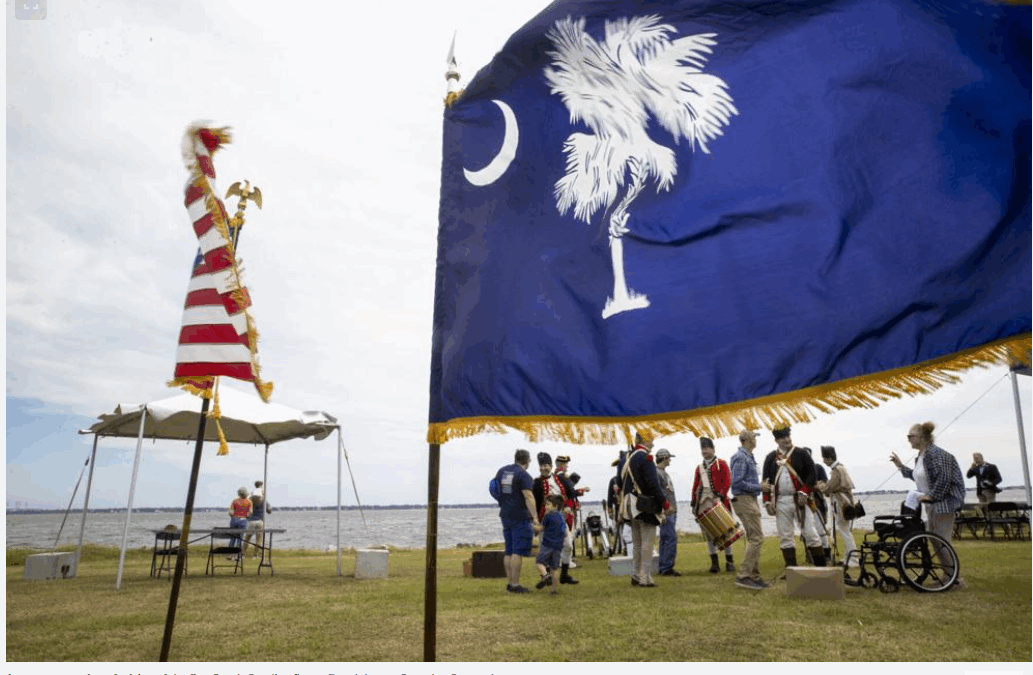
But the flag has almost exclusively been described as blue. Some elements, like the Palmetto tree or the word “liberty” written on the crescent, would come later.
Gen. William Moultrie, the commander who led the Continental Army’s 2nd South Carolina Regiment and ordered the creation of the flag, detailed it as a “large blue flag made with a crescent in the dexter corner” in his 1802 “Memoirs of the American Revolution.”
The reference to a green flag stumped Butler.
Could it be that the British officers mistook the blue flag for green? Perhaps the light was playing tricks on them, Butler thought. Maybe the logs were penned by two detail-oriented, colorblind sailors?
“It took me a while to come around to the idea that, no, maybe that’s exactly what color it was. And if that’s true, then hey, that’s kind of fun because that really shakes things up,” Butler said.
Butler noted that at the time, the flag was used for the purpose of signals or communication, which could explain the differing color.
“I’m not trying to make a definitive case saying the original color was green, and then later it turned blue,” Butler said. “It was probably any color that they wanted it to be, on whatever occasion they needed it to be.”
Butler details the discovery and dives into his theory for the alternative flag color in a brand-new episode of the Charleston Time Machine that aired Dec. 19.
“This episode of the Charleston Time Machine is a reminder that Charleston’s best-known stories often have lesser-known perspectives. It is a great example of Dr. Butler’s tireless efforts to uncover the overlooked moments and voices of our area’s history,” said Doug Reynolds, a spokesperson for the Charleston County Library.
Charleston Time Machine can be accessed online at ccpl.org/charleston-time-machine and on streaming platforms like Spotify and Apple Podcasts.
–postandcourier.com