SOUTH CAROLINA: With location and design selected, SC’s Robert Smalls monument needs funding
The monument is expected to cost between $1 million and $2 million for the cost of the sculpture, lights and security cameras
COLUMBIA — The Statehouse’s planned monument to Civil War hero Robert Smalls has a location. It has a design.
What Smalls’ monument, the first on the grounds honoring an individual Black person, needs next is funding.
The monument, which legislators unanimously approved adding to the Statehouse grounds in 2024, will likely cost between $1 million and $2 million, Mike Shealy, who oversees special projects for the Department of Administration, told a commission of legislators Thursday.
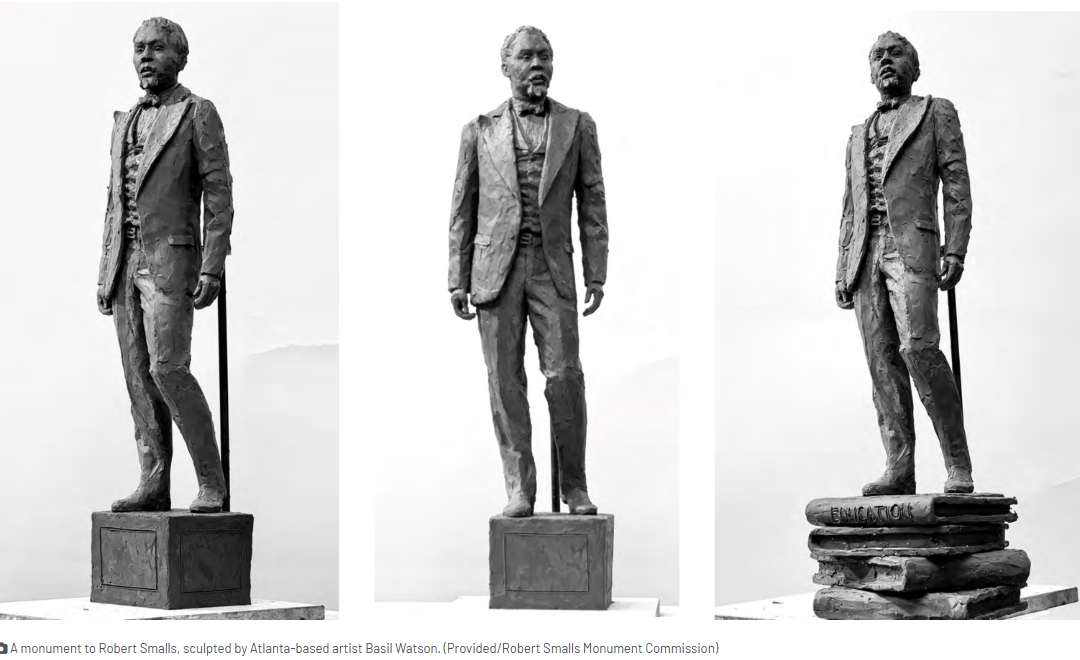
That will include the cost of lights, cameras and, of course, the sculpture itself, which legislators selected Atlanta-based artist Basil Watson to create after receiving proposals from six artists.
Watson’s design depicts Smalls, who escaped slavery on a Confederate steamship, in a three-piece suit, as he would have worn when he served in the Statehouse and in Congress.
That’s similar to what the University of South Carolina paid for Watson’s monument depicting the first Black students admitted to the school post-Reconstruction, unveiled in 2024, Shealy said.
All of the funding must come from donations. So far, the commission has collected about $35,000, and at least part of that will go toward marketing costs to try and raise as much as possible, Shealy said.
After nearly two years of approvals to get the monument underway, “we are now in the fundraising phase,” allowing donations to begin in earnest, Shealy told legislators, who applauded the announcement.
The legislation that approved memorializing Robert Smalls on Statehouse grounds and created the commission specified that private donations pay for the monument.
The question legislators now face is how to get the word out.
“This needs to be a grassroots type of campaign,” Shealy said.
Shealy suggested a ceremonial groundbreaking to signify that the project was officially underway at the bare patch of land near the Statehouse’s public entrance where the monument will stand.
Perhaps that could coincide with Juneteenth, which takes place on June 19 to commemorate when slaves in Texas finally learned of their freedom, since Smalls escaped slavery, suggested Rep. Jermaine Johnson.
Maybe some of the major companies located in South Carolina could donate to help show off that part of the state’s history, the Hopkins Democrat suggested.
Soliciting those sorts of major donations will be up to former Sen. Gerald Malloy, who leads the monument’s fundraising committee after narrowly losing a Senate race in 2024.
Or, a sign at the Statehouse could tell visitors about Smalls and ask for donations, said Sen. Chip Campsen, an Isle of Palms Republican who gave fellow senators a history lesson about Smalls on the floor.
Born into slavery in Beaufort in 1839, Smalls was sent to Charleston at age 12. After the Civil War began, Smalls became a pilot on a Confederate steamship. Smalls later hijacked that same ship to deliver himself, his family, and other enslaved workers to freedom, disguising himself as a Confederate captain to trick his way to the Union blockage in Charleston Harbor.
Smalls became the first Black man to pilot ships for the U.S. Navy, commanding the same ship he used to escape. He used the prize money Congress awarded him for the capture of that ship to later buy at auction the mansion of the man who enslaved him.
During the Reconstruction era after the Civil War, Smalls joined a majority-Black convention of delegates to write the 1868 state constitution undoing the Black Codes and promising free education for all children and voting rights for all men. He spent five terms in the U.S. House, after a stint in both Statehouse chambers.
The state constitution rewritten in 1895 formally rolled back education and voting rights and ushered in the Jim Crow South. Smalls, a Black delegate to the mostly white 1895 convention, pleaded for a constitution guaranteeing “fair and honest” elections, even while recognizing the purpose of the convention was to disenfranchise Black voters.
A small portrait of Smalls and a biography near the governor’s office tell that story. Perhaps all that’s missing is a digital barcode allowing people to easily donate, Campsen said.
“I think people would (donate) if they really knew what Robert Smalls did and his significance,” Campsen said Thursday.
-scdailygazette.com/