Most people think of wars being won by a series of victorious battles. North Carolina’s contribution to the last winning days of the American Revolution’s last phase was that it was the site of a great retreat.
I attended an event recently that commemorated this immensely important action — called the “Race to the Dan.” We met at a new state historic site beside the Shallowford crossing of the Yadkin River, just west of Winston-Salem, and discussed the many aspects of the race to the Dan River on North Carolina’s northern border.
Why does the Race to the Dan matter? The chess match that ensued as British Gen. Lord Cornwallis chased Patriot Gen. Nathaniel Greene in 1780-81 north through North Carolina after the American victory at Cowpens, South Carolina, helped strategically result in the final American victory at Yorktown months later in 1781.
The Patriot victory at Cowpens occurred in Jan. 17, 1781. Dr. Wayne Lee of UNC -Chapel Hill, who served as chair of military history at West Point in the 2025-2026 academic year, spoke to the crowd about how in colonial times the weather had a huge impact on military campaigns.
Back in those days, the winter months typically meant rainy weather, and as a result: swollen, flooded rivers.
Lee used a map to show that coming out of the Cowpens battle, winning Patriot Gen. Daniel Morgan moved his troops north into North Carolina, intending to join forces with Greene. Cornwallis was furious to learn of his troops’ defeat at Cowpens and moved his troops from his base in the Charlottetown area to give chase to the rebellious Patriot army.
Lee described with maps in detail how Morgan and Greene had to push their army through a wilderness with very few roads and, more importantly, faced the need to cross large rivers like the Broad, Catawba, and Yadkin in order to escape Cornwallis’ chase [some of these rivers today are dammed up to form lakes].
This retreat is known in military history circles as an ingenious strategy by Greene to survive and keep an army in the field against one of the best experienced generals in the world — Lord Cornwallis.
Why didn’t Greene’s army just cross these rivers at a bridge you may ask? There weren’t any — at least for rivers this wide. If one was to cross a big river, you had to find a low place in the river to get your horse or wagon to cross, or you got across by boat or ferry.
The fact that Greene was able to cross all these Piedmont North Carolina rivers — and safely reach the north side of the Dan River on the border with Virginia — was an amazing feat.
It wasn’t like Cornwallis wasn’t nipping at his heels. As Greene’s forces reached each river, it seemed like he either crossed just before the river waters rose too high, or he had planned well enough ahead to have boats available for crossing — leaving Cornwallis seething with anger on the opposite side of the river as Greene’s men scampered to safety.
The event at the Shallowford crossing of the Yadkin was put together to symbolize and highlight the importance of the Race to the Dan, and the new historic site will serve to illustrate to visitors the realities of war in colonial times.
Early in the morning, the group walked down a long path to the Shallowford crossing to see where Cornwallis’ army was forced to cross the Yadkin in early February 1781. The ford is called the Shallowford because it has a flat rocky bottom that is shallow enough for wagons, horses, and even people on foot to cross when the water is low.
Which it wasn’t at the time of the event. As we approached the river crossing site, the decision was made that the week’s rains had raised the river to over waist deep and too dangerous for the British reenactors who were supposed to retrace the march by Cornwallis’s army across the river. Just a week before, a trial run crossing of the Yadkin was done in two-feet deep water.
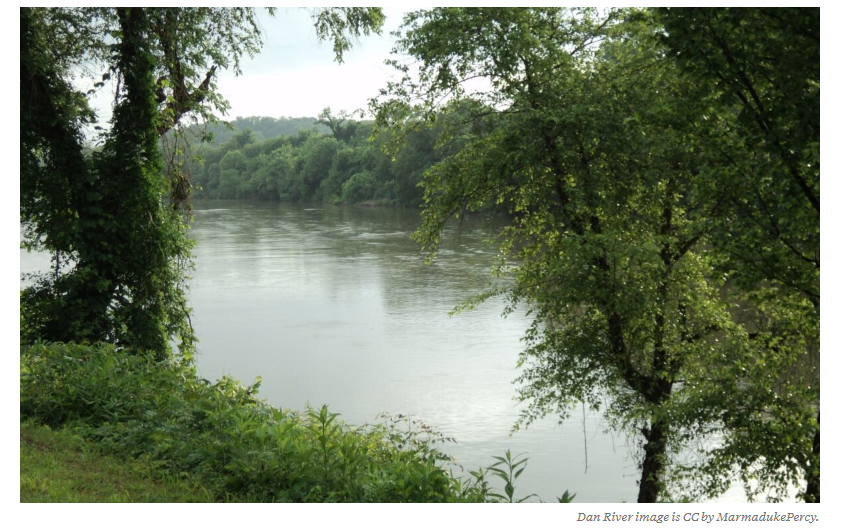
Although disappointing, it was a realistic realization of how travel in colonial times depended on weather and the forces of nature, especially when you saw firsthand how swift the current appeared to be in the wide waters of the Yadkin River.
Why was Cornwallis crossing at the Shallowford crossing of the Yadkin? In his chase after Greene’s army, he was supposed to be crossing right on their heels at the Trading Ford crossing of the Yadkin where today’s I-85 interstate bridge crossed the mighty river. Alas, Greene had pushed his army hard and fast enough to get across the river just in time to make it before it became too deep.
So Cornwallis was forced to instead move his army northwest to the Shallowford crossing.
The delay was a huge factor in Greene’s escape in the Race to the Dan River and keep his army alive to fight another day. Greene’s army resupplied and healed up in Virginia, and a rested army then came back a few weeks later to meet Cornwallis on Greene’s terms at the Battle of Guilford Courthouse — a battle that Cornwallis technically won but with such huge losses of key soldiers that he was weakened until he ultimately left North Carolina for Virginia in the fall of 1781 and ultimately lost at the Battle of Yorktown.
Why did escaping Cornwallis’ army matter so much in the Race to the Dan?
If somehow Cornwallis had trapped Greene at one of these large rivers, and forced him to surrender his forces, the war would have been over in the southern colonies, which then would have enabled Cornwallis to move north and join other British armies in going after General George Washington’s army and ultimately crush the Patriot rebellion.
Important? I’d say so. Is it well-known? Not really, and that’s why events like I attended are so important in showing how precarious the Revolutionary fight was in North Carolina. I say it probably too much, but if any one of the the Patriot actions had failed and the British were able to crush the fight for freedom in the North Carolina colony, and ultimately the Patriot fight for freedom in the other 13 colonies, the Declaration of Independence would have meant nothing and we might still be a British colony.
It is interesting that Washington wisely chose Greene to lead the Patriot army of the south only months before the Race to the Dan. You see, Greene had served as Washington’s quartermaster general in the northern battles and understood firsthand the operational significance of supplying and moving armies. Dr. Lee strongly emphasized Greene’s genius in quickly learning the geographical hurdles facing him, the number of rivers and terrain he had to deal with, and how to nimbly outmaneuver his British adversary.
A number of articles detail the importance of the Race to the Dan. There are also some excellent maps that show the route taken by Morgan after Cowpens and how he joined up with Greene for the march north that goes from the South Carolina border to Virginia.
I encourage you, if you are close enough, to go to these large rivers and see firsthand what it must have been like to know you had to cross these rivers to safety with no bridges.
As we have said, the Declaration of Independence and the Fourth of July were just the beginning of the fight for independence. For the next five plus years, our country will celebrate the 250th anniversary of this great fight for freedom for the liberties cherished today by people throughout the world.
–carolinajournal.com