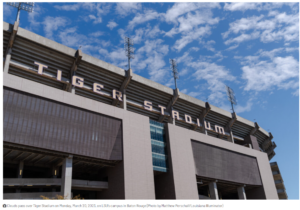
TEXAS: State Looks to Superme Court to Block Confederate License Plates

-DallasNews.com
###
VIRGINIA: Richmond’s American Civil War Museum in Design Phase
RICHMOND, Va. – The American Civil War Museum (ACWM) in August released the overall site and specific conceptual plans for the 35,000-square-foot facility to be built at Tredegar, along the James River.
The ACWM was formed in November 2013 by a merger of the Museum of the Confederacy (MOC) and the American Civil War Center. The new building will house the combined artifacts from the two museums. In the meantime, both facilities remain open.

The Conceptual Site Plan for The American Civil War Museum shows the new building in foreground on Tredegar Street, historic buildings in orange and 4.25 acres of open space.
Co-CEOs Waite Rawls and Christy Coleman told Civil War News about the latest developments.
According to Rawls, the design plans are in draft form only. “We’re making adjustments and should be ‘finished-finished’ by mid-September,” he said.
The architect is Baskervill, a Richmond firm. The exhibit design firm has not yet been selected.
The project timetable will be determined at a fall board meeting. If an accelerated schedule is chosen, Rawls said the groundbreaking would be this coming December.
The price tag for the whole project, including a financial reserve, is $34 million. Rawls said that includes costs like constructing the new building and moving the collection from the Museum of the Confederacy on Clay Street to the new facility.
The funds raised so far are “already over $20 million,” according to Rawls.
Planning and designing have cost $1 million to date, Coleman said, including focus groups, public relations, architectural design fees and construction management fees.
Coleman said her biggest surprise so far during the planning and design of the new facility is “how small a space can become as you begin to identify all of the varying needs.”
Rawls said he was surprised how well things have gone – especially how helpful getting regular feedback has been. He said he wished they had used a similar feedback cycle when planning the Museum of the Confederacy-Appomattox three years ago.
Previously Rawls had said that there would be additional hiring, not layoffs, as the merger of the two museums comprising the ACWM proceeded (see January CWN).
Coleman confirmed that prediction, saying that they have added three full-time positions and have hired part-time seasonal workers. She called staff morale “overall, pretty good.”
Rawls said, “One of the things we did smart early on was we moved some people around.”
For example, Rawls and Coleman consolidated the marketing people by having those at Tredegar join their counterparts at the Museum of the Confederacy.
Likewise the development staff was shifted from Clay Street to join their counterparts at Tredegar, Rawls said.
“People are thinking functions more than who did they used to work for,” Coleman said. “They think about how collections interacts with development, rather than how Tredegar interacts with MOC.”
There are no longer MOC or Tredegar staff meetings, but instead a collections meeting or a development one, Rawls said.
A major change for the formerly independent museums is the ACWM leadership structure with two co-CEOs instead of one.
“It’s working just fine,” Coleman said. “Generally speaking, if we have a disagreement about something, we can go off in the corner somewhere and work it out. Ninety percent of the time, that’s the case.”
She noted a structure is in place through the executive committee so that if the CEOs reach an impasse “there’s a way for it to be resolved.”
The ACWM logo features the tagline “Confederacy, Union, Freedom” beneath the silhouettes of a woman, an African American and a soldier.
“We got an awful lot of very interesting, very positive feedback from members, visitors and newspaper readers about the logo,” Rawls said. “The logo has helped solidify that the war is about the people and not about dates and casualty counts.”
Only “quite a small number” of MOC members have “pushed back” against the new logo and merged museums concept.
“Most of those who are unhappy were not MOC members previously,” Rawls said. “In comparison, we have picked up support from a whole lot of people who’ve said everything from ‘It’s about time’ or ‘This makes sense’ or ‘I look forward to the new thing.’ A lot of positive feedback.”
There is a misconception Rawls would like to dispel — that the former MOC is giving away or selling its collection.
“We’re not selling, not donating, not transferring ownership of anything,” he said.
The corporate entity that owned the MOC collection when the MOC was an independent museum – the Confederate Memorial Literary Society – continues to own that collection (see January CWN).
If the museum groundbreaking takes place in December, the MOC facility on Clay Street will not close until the winter or early spring of 2016 so that the collection can be moved to Tredegar.
The new museum first will have to go through a “clean cycle,” according to Coleman, before anything can be placed inside.
That means the heating and air conditioning system will have to bring the level of dust, odors and humidity to acceptable levels, a process estimated to take from three to six weeks.
In 2015 the former Museum of the Confederacy building on Clay Street will be featuring Confederate-themed exhibits as always, Coleman said. Likewise, the former American Civil War Center at Tredegar will be open and most of the dramatic changes on the grounds will happen during next year.
-civilwarnews.com
###
VIRGINIA: Restoration of Civil War Battlefield Under Way
BRANDY STATION, Va. — With a brick ranch house in its immediate sights, demolition equipment began removing modern intrusions on Fleetwood Hill at Brandy Station battlefield last month.
The Civil War Trust, which bought 56 acres including the crest of the hill on the cavalry battlefield for $3.6 million in August 2013, received major donations beyond the purchase price to pay for the restoration.

The Civil War Trust’s Matt George and Garry Adelman show off the Fleetwood Heights Road (State Route 685) brass address marker that until recently indicated the large home on Fleetwood Hill behind them. (Clark B. Hall photo)
The Tony Troilo family lived on the hill for more than 40 years until earlier this summer. The ranch house close to Route 685 had been the family home. Troilo moved into the 7,200-square-foot house on the crest in the late 2007.
According to the Trust, the first phase of restoration is demolition, which was approved by the Virginia Department of Historic Resources, which holds a conservation easement on the property. The contractor is J.K Wolfrey of Spotsylvania County who has worked with the Trust and National Park Service on projects.
Trust Deputy Director, Communications Mary Koik says there is a 90-day window for work, which weather and other factors can affect. It is expected demolition of the big house will begin in September.
In addition to the two houses, the property includes two in-ground swimming pools, a pool house, detached garage, ornamental landscaping and an asphalt and concrete driveway. A local 4-H club has already taken an aluminum barn for its use.
According to the Trust’s project plan the basements and pools will be backfilled and graded to historic contours as closely as possible with the assistance of historical photos. Some trees will be kept and a section of paving off Route 685 will be retained for visitor parking.
Long-term restoration will include replanting some trees on the hill’s crest to resemble its wartime appearance. A farming plan for other parts of the property includes a five-year agricultural lease.
The Trust is developing a multi-stop interpretive walking trail it hopes to install next spring. The aim is for visitors to be able to stand on the crest and visualize the battle scene.
More than 18,000 cavalrymen and 3,000 Union infantry fought at Brandy Station, which historians consider the beginning of the Gettysburg Campaign.
The epicenter of the fighting was Fleetwood Hill, which overlooked much of the battlefield and served as Confederate Gen. J.E.B. Stuart’s headquarters.
Battle historian Clark B. “Bud” Hall has called Fleetwood Hill “without question the most fought over, camped upon and marched over real estate in the entire United States.”
Hall said the hill was of strategic importance because artillery placed there controlled five important road junctions that converged in Brandy Station village three quarters of a mile away. The Orange and Alexandria Railroad passed the southern base of the hill.
“Although it is most closely associated with the climactic fighting of June 9, 1863, there were, in fact, 21 separate military actions on Fleetwood Hill during the Civil War,” according to Hall.
The land acquisition was accomplished in August 2013, following a $3.6 million fundraising campaign.
The Civil War Trust credits private gifts and matching grants from the federal Civil War Land Acquisition Grant Program, which is administered by the National Park Service’s American Battlefield Protection Program, and the Commonwealth of Virginia’s Civil War Sites Preservation Fund.
Partners included the Central Virginia Battlefields Trust, Journey Through Hallowed Ground and the Brandy Station Foundation.
The Trust has protected more than 1,800 acres at Brandy Station. It opened an interpretive trail in June 2003.
More information is at www.civilwar.org, click “battlefields.”
-civilwarnews.com
###
TENNESSEE: New State Veterans Cemetery Next to Parker’s Crossing Battlefield
PARKERS CROSSROADS, Tenn. — Gov. Bill Haslam along with Tennessee Department of Veterans Affairs Commissioner Many-Bears Grinder recently announced that the new state veterans cemetery will be in Parkers Crossroads.
The Tennessee State Veterans Cemetery at Parkers Crossroads will be next to Parker’s Crossroads Battlefield Park.
The cemetery project was started about two years ago to assist veterans in this rural part of Tennessee since the state’s four veterans cemeteries are about two hours away from several counties in the Parkers area.
A committee of veterans selected the final location after visiting dozens of potential sites, according to West Tennessee State Veterans Cemetery Steering Committee Chairman Chris Dangler.
A Vietnam War veteran from nearby Lexington, he said the process was smooth with everyone working together for the “good of the veterans.”
The 132-acre site lies on the north side of Interstate 40 with easy access to the battlefield and the interstate. It is about half way between Nashville and Memphis.
The Dec. 31, 1862, Battle of Parker’s Crossroads occurred between forces commanded by Confederate Gen. Nathan Bedford Forrest and Union Gen. Jeremiah Sullivan.
After finding his command surrounded, Forrest uttered the now-famous order, “Charge ‘em both ways.” They did and were able to escape the trap.
State Rep. Steve McDaniel, a historian of Parker’s Crossroads Battlefield Association, led an effort to save the battleground, which the Interstate slices in two. The first land purchase, 56.08 acres, was made in 2001.
The battlefield, now well interpreted, is owned by the state and managed by the city. At just shy of 350 acres, the most significant land has been saved, according to McDaniel. No additional major purchases are anticipated.
Expressing his delight with the veterans cemetery, McDaniel noted there “was no major fighting on the new parcel.” Battlefield tour stop 4 at a water well where soldiers filled their canteens is a few feet from the new cemetery entrance. Also nearby is the Jones Cemetery where many of the area’s first residents are buried.
Kimberly Parker, a direct descendant of the city’s namesake, said veterans, spouses and officials of the surrounding counties will serve as a cemetery support committee.
The committee is already planning a sewer system, chapel and the overall layout. The estimated cost of the cemetery will be $5.5 million from federal funds as well as donations and various local government and state assistance.
The cemetery is scheduled to accept the first interment in 2016 and is expected to serve over 45,000 veterans.
Noting the area’s rich history, McDaniel said, “We welcome the opportunity to offer a reverent backdrop to this future field of honor.”
For information about contributing contact the Tennessee Department of Veterans Affairs at www.state.tn.us/veteran