California: Confederate Flag Controversy Rekindles Name Dispute
Two longtime Marin residents are calling for the Dixie School District to change its name, a decades-old demand revived by the national controversy over various associations with the Confederacy and racism.
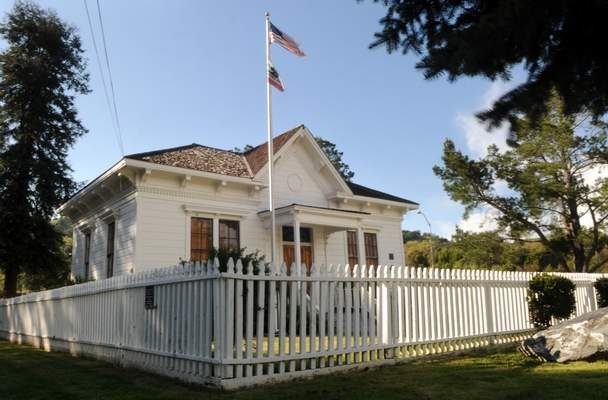
The old Dixie schoolhouse in San Rafael was named during the Civil War in reference to the South on a dare to the man who had it built, James Miller, according to one story. IJ photo Alan Dep
Kerry Peirson of Mill Valley and Noah Griffin of Tiburon are spearheading the movement to change the San Rafael district’s name. To these activists, and to Marin residents from similar movements in 1997 and 2003, “Dixie” is a Confederate anthem that conjures images of the slave era, racism and the Ku Klux Klan.
South Carolina last month took down the Confederate battle flag, a powerful symbol of slavery and the Old South that has roiled emotions in South Carolina for decades. The move was sparked by the slaughter of nine African-Americans at a church Bible study by an accused shooter who is an avowed racist.
The decision reverberated around the country, and Peirson and Griffin say it’s time to take similar action.
“I’m hoping that Marin has evolved on these issues and is ready to embrace a new name and a new start for this old and distinguished school district,” said Peirson, a local political activist and former Marin Community Foundation trustee.
“In the arguments going on in South Carolina and other places, at least those supporting the (Confederate battle) flag have an argument because they are in Dixie. For that to be here in California, it’s inappropriate to the state,” Peirson said.
District’s response
Brad Honsberger, president of the governing board of the Dixie School District, was reluctant to say too much about the proposal.
“My understanding is that our district is named after Mary Dixie, a descendant of the Miwok Indian tribe, and she used to live in Vallecito, California. There is no relation to the Confederate flag,” he said.
Honsberger said he could not recall the name of the book or who showed it to him, “but I do remember seeing it with my own eyes.”
Asked if he was receptive to changing the name, he said, “It wouldn’t be my decision. I couldn’t comment on that.”
Asked if he would be willing to give the proposed name change a hearing by putting it on the agenda of the next school board meeting, Honsberger said, “I don’t have a comment on that.”
Other school board members did not return calls seeking comment.
‘Obama District’
The suggestion comes at the same time Sen. Steve Glazer, D-Orinda, introduced a bill in the California Legislature that would prohibit using the names of Confederate elected and military leaders on state and local property.
Glazer also sent a letter to Fort Bragg Mayor Dave Turner asking the city to eliminate its connection with Braxton Bragg. Bragg was a U.S. Army officer when Fort Bragg was named for him but later became a Confederate general.
The Board of Trustees of the Dixie School District held public hearings on the Dixie name in 1997, voting to continue using it.
In the 1990s, “I went to the school board meeting and asked them to consider it (changing the name),” Peirson said. “The room turned into the antebellum South. I was called a gorilla. I was afraid.”
In 2001, the appropriateness of the district name was brought up by several speakers during hearings of the county Committee on School District Organization. Several speakers called the name “Dixie” offensive.
In 2003, district Superintendent Thomas Lohwasser was presented with a petition signed by 23 residents who wanted the name changed to the Miller Creek Elementary School District. Lohwasser could not be reached for comment last week.
Peirson said, “I don’t want it to be like we are forcing them to change the name. I want it to be like South Carolina where they decided it was best.
“Name it the Obama School District. We will be the first of many,” Peirson said. “Wouldn’t that be a delicious outcome?”
Little Rock Nine
Griffin said he wouldn’t mind the school district being named after President Barack Obama, but his idea would be to call it the Glenn Robinson School District, after the late African-American school trustee from Marin.
“Glenn Robinson was on the (Marin County) school district board for 40 years. I would not be against ‘Obama,’ but because of Glenn Robinson’s service and local ties to Marin County, I would suggest that name,” said Griffin, a public affairs consultant, speaker and musical performer who is an IJ columnist and former public member of the IJ’s editorial board.
“I equate the massacred nine in Charleston with the massacred Little Rock Nine who opened the way to school integration,” Griffin said. “There were nine martyrs to the cause in Charleston. You never know what your life is going to stand for, but because they gave their lives we are looking at putting the Confederate flag where it belongs and looking at the symbols fraught with meaning, especially for the African-American community.”
The word “Dixie” is one of those symbols, Griffin and Peirson said.
“Dixie is synonymous with the Old South, the slave-bearing antebellum South,” Griffin said.
The history of the name’s origin is uncertain. Evidence from the Anne T. Kent California History Room backs assertions that the name was chosen on a dare by a Southerner who participated in the building of the old Dixie schoolhouse in 1864 on land donated by James Miller.
Griffin said his research shows that Miller, a slave owner from Missouri, purchased the land and gave the district its name.
Another theory suggests the school was named after land grant owner Don Timoteo Murphy’s daughter, Dixie.
Huffman’s view
Marin Supervisor Damon Connolly, a former Dixie School Board member whose supervisorial district includes the Dixie district, also did not return calls seeking comment.
When contacted, Connolly’s aide, Chris Calloway, said, “I mentioned it to him (Connolly) and it’s something he has no background in or knowledge of.”
Rep. Jared Huffman, D-San Rafael, introduced legislation in the U.S. House of Representatives this month to ban federal display and sale of the Confederate flag under certain circumstances.
Asked about the Dixie district proposal, Huffman said he “always wondered about the origin of the Dixie School District. It has always seemed a little out of place to me.
“But dictating from Congress as to how a school district names itself is not my purview. I will let the community sort this out. My job it to fight for as much education funding as I can get,” regardless of the name, the congressman said.
“I think we’re going to have an ongoing national discussion about symbols of the Confederacy and memorials that for many people are promoting the wrong values and I think that’s healthy,” Huffman said. “But I’m not saying that the Dixie School District needs to change its name. That’s for my constituents in the district to decide.”
–mercurynews.com
North Carolina: Civil War Historic Sites Get Grants
A historic building in Lincolnton has received two grants for assessments related to repairs that officials hope can be made in the near future.
The Pleasant Retreat Academy/Memorial Hall building located at 129 East Pine Street in Lincolnton is owned by Lincoln County and has been leased to The United Daughters of the Confederacy since 1909.
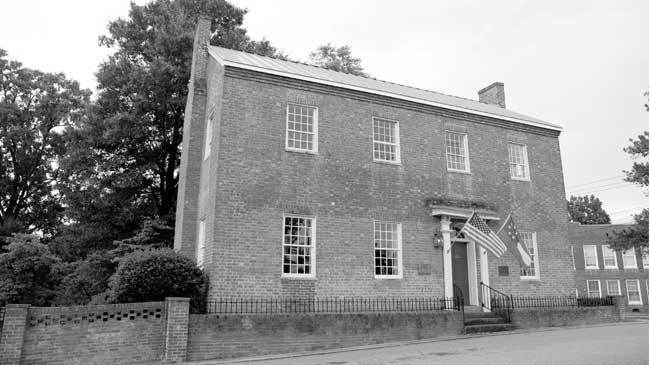
The Pleasant Retreat Academy and Memorial Hall at Pine and Academy Streets in Lincolnton.
The building serves as the earliest brick structure in Lincolnton. It was chartered in 1813 and built between 1817 and 1820 and is listed on the National Register of Historic places.
From 1825 to 1965, the building served as Lincoln County’s first public library. The building served as a school at various times in history and famous former students include Major General Robert F. Hoke, Major General Stephen Dodson Ramseur, Georgia Governor Hoke Smith, North Carolina Governor William A. Graham and Texas Governor James Pinckney Henderson.
“I talked to former county manager, Tracy Jackson, about having a conditions assessment done on the building,” Lincoln County Historical Association director Jason Harpe said. “The reason for that is because you can have a professional tell you what the issues are and what needs to be done to remedy them and tell you how much it is going to cost. This also prevents someone from tackling projects within the building that they have no experience with.”
With the blessing of the county, Harpe applied for a grant through the Marion Stedman Covington Foundation in Greensboro. The foundation awarded what stood as half of the cost of the assessment.
An architectural services fund grant was applied for through the Lincolnton Downtown Development Authority (DDA) and was awarded.
The total cost of the assessment is $6,500. With the Marion Stedman Covington Foundation awarding $3,250 through the grant, arrangements had to be made for a $2,500 grant via the DDA, which was awarded and contributions from the UDC and the Lincoln County Historical Association helped to secure the funds needed for the project.
“The architectural services grant is a City of Lincolnton program that was established a number of years ago to encourage good design projects, capitalizing on the rehabilitation of existing structures,” said Community and Business Development department director Vicki Davis. “Not only is it important that we support the preservation of our historic places, the Architectural Services Grant provides funding to engage experts in the field of preservation to ensure appropriate application of the Secretary of the Interior’s Standards for Rehabilitation.”
According to Harpe, areas of the building need to be “repointed.” The process is related to the deterioration of the original mortar. Moisture issues are present and causing various problems, some of which are believed to be related to the planters in front of the building holding moisture. The planters and the wall in front of the building also serve as protection from automobiles since the building sits at a close proximity to a corner and the building could be damaged from accidents without their presence.
If the planters are removed, the county would have to devise a way to protect the building from a potential accident.
The building also faces some issues related to windows on the second floor and a need for gutters is on the agenda.
“I don’t think the county is in a position to put a lot of the money in the building and that is understandable,” Harpe said. “Since the building is county owned, it will probably have to go through their procurement process. I am suggesting to all parties that we will need to apply for a grant to get the gutters and the repointing done. These projects will have to be done in phases.”
Harpe noted that Lincoln County Manager Kelly Atkins has unique perspective for such projects.
“As the former county planning director, Kelly knows a lot about these historic buildings,” Harpe said. “I will make sure the assessment gets into Kelly’s hands so he can see what probable cause the assessor comes up with and we will go from there.”
–lincolntimesnews.com
###
VIRGINIA: $1,500 Offered for Information on Confederate Monument Vandalism
RICHMOND, Va. — Richmond Police are offering a $1,500 reward for any information that leads to the arrest of vandals who struck a Confederate monument last month.
The reward, funded by the Virginia Flaggers, is offered to help catch the person responsible for spray-painting “Black Lives Matter” on the Jefferson Davis Monument on June 25. Work to remove the paint continues more than a month later.
Anyone with information on the case is asked to call Richmond Police Captain Emmett Williams at (804) 646-1412 or email [email protected].
CLICK HERE TO SEE PHOTOS OF THE VANDALISM: http://shout.lt/610j
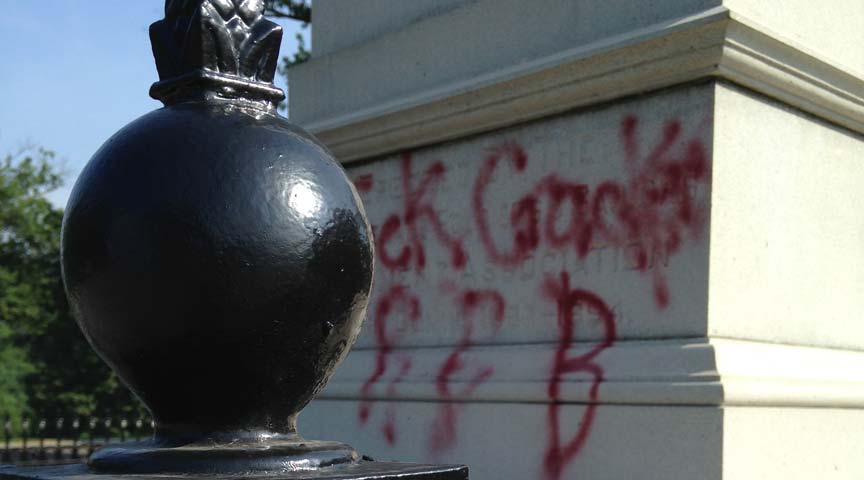
VANDALS HIT RICHMOND’S CONFEDERATE MONUMENTS
Vandals spray-painted graffiti on the Confederate Soldier and Sailors Monument at Libby Hill Park overnight.
City workers power-washed the graffiti off the more than 100-year-old monument, but weren’t able to remove all the writing. Protesters holding signs that also said “Black Lives Matter” demonstrated at the site after the vandalism. At one point a man donning a Confederate flag bandanna arrived with a can of “Goof Off” spray paint remover and tried to further remove the graffiti, although it may have actually done more damage to the monument in the process.
Another man also vandalized the monument days later. Joe Weindl pleaded guilty in court Thursday to tagging an “L” for loser on the statue on June 28. He reportedly spray painted the L in opposition to Confederate relics and monuments. He was charged with destruction of city property.
Weindl was sentenced to 90 days suspended and 100 hours of community service. He will be on probation for three years. His attorney, Daniel Watkins, said earlier this week that his client regrets the action. Weindl says he didn’t spray paint the “black lives matter” graffiti onto the monument. No arrests have been made in that vandalism case.
Jefferson Davis was President of the Confederate States of America. The monument was sculpted by Edward Valentine and unveiled on June 3, 1907. It is one of several dedicated to the Confederacy along Monument Avenue in Richmond. Others include Robert E. Lee, Stonewall Jackson, and Fontaine Maury. A monument to Richmond-native Arthur Ashe was added in 1996, three years after the tennis player’s death.
Monument Avenue is now home to several historic homes and is a highlight for tourists and home to events in Richmond. Each year tens of thousands run past the monuments during the Monument Avenue 10k. The upcoming Richmond 2015 UCI Road World Championships will include Monument Avenue on many of the courses in September. However, a group known as the Defenders for Freedom, Justice and Equality has called for the course to be moved.
Vandals also spray-painted graffiti on the Confederate Soldier and Sailors Monument at Libby Hill Park a few days later.
Red spray paint reading RBGZ and an upward arrow covered one side of the base, while vandals wrote explicit language and the initials R. E. B. Richmond Police did not immediately respond to a call for comment and it is unknown whether there are any suspects.
The monument was built in 1894 on 29th Street atop Libby Hill and has a bronze Confederate soldier standing on top of a towering pillar.
The Confederate monuments in Richmond have been the subject of debate, as Confederate flags came down following the deadly shootings in Charleston.
–nbc12.com
###
VIRGINIA: Chesterfield Has Most Confederate License Plates
With nearly one-quarter of Virginia’s Sons of Confederate Veterans license plates, the Richmond region is one of the state’s top strongholds for Confederate heritage supporters, according to an analysis of statewide data showing where the controversial plates are located.
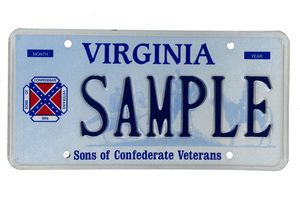
A sample of the Sons of Confederate Veterans license plates.
Of the five localities with the most Confederate plates, four are in the Richmond area. With 397 of the state’s 1,691 Confederate plates, the Richmond and Tri-Cities region has the largest share of the plates that Gov. Terry McAuliffe has called “unnecessarily divisive and hurtful,” according to data provided from the Virginia Department of Motor Vehicles.
Chesterfield County tops the list with 111 plates, while Hanover County is second with 66. Next up are Virginia Beach (53), Prince George County (50) and Henrico County (44).
“Richmond was the capital of the Confederacy,” Frank Earnest Sr., a former commander of the SCV Virginia Division who now serves as the group’s spokesman, said in an interview this week. “We’ve got a lot of camps in that area.”
The Richmond region’s overall population is one reason it tops the list when looking at raw numbers of plates. On a per-capita basis, Southside Virginia tops the list, followed by eastern Virginia, Southwest Virginia and the Shenandoah Valley, including Roanoke.
Prince George has the most plates per capita, with 13.72 per 10,000 residents. It is followed by Highland County (13.06), Brunswick County (12.18), Colonial Heights (12.16) and Craig County (11.37).
Earnest said the areas with the highest concentrations of Confederate plates coincide with where the most active SCV camps are located.
“We’re like churches or any other group,” Earnest said. “There’s ones that are really out there doing, making a difference. And there’s others that are just like, ‘Well, we’re here.’ ” If McAuliffe has his way, the plates, which feature a version of the Confederate battle flag as part of the SCV logo, will disappear altogether. After the racially motivated massacre of nine black churchgoers June 17 in Charleston, S.C., and a U.S. Supreme Court ruling in June that found state governments may censor specialty license plates, McAuliffe has sought to phase out the Confederate plates.
A federal court hearing is scheduled this morning in Danville on the state’s move to recall the plates, which the SCV is expected to fight.
The license plate data aren’t a perfect representation of where Confederate sympathies are strongest in the state.
The plates are available only to SCV members, and membership is limited to male descendants of those who fought for the Confederacy. With about 3,000 Virginia members, a little more than half of the group’s membership has a specialty plate. And some members might have multiple plates for multiple vehicles.
The per-capita figures are based on July 2014 population estimates from the University of Virginia’s Weldon Cooper Center for Public Service. The analysis also used Weldon Cooper’s definitions of the state’s eight regions.
In many ways, the numbers are another sign of Virginia’s larger demographic and cultural divide, with more rural localities generally having more Confederate plates than population centers such as Hampton Roads and Northern Virginia.
Northern Virginia, in particular, is significantly lighter on Confederate heritage support than the rest of the state. Despite having more than one-third of Virginia’s population, it has less than one-tenth of the state’s Confederate plates, mostly in Spotsylvania, Fauquier and Stafford counties.
Earnest wasn’t surprised by the disparity.
“There aren’t any Virginians in Northern Virginia,” said Earnest, a resident of Virginia Beach. He added that it was mainly Northern Virginia that put McAuliffe in the governor’s office.
At the SCV national reunion in Richmond this month, several attendees suggested McAuliffe doesn’t understand the complexity of Confederate symbols because he’s not a native Southerner.
“How does one man from Syracuse, New York, get to decide that?” said Ben Jones, spokesman for the national group, when asked about McAuliffe’s move to ban the plates.
Jones, a former Democratic congressman from Georgia who now lives in Rappahannock County, is best known for playing Cooter on the TV show “The Dukes of Hazzard.”
“The Virginia that Governor McAuliffe is trying to build is one in which anyone is welcome to come here, live, create jobs and enjoy a high quality of life,” said McAuliffe spokesman Brian Coy. “He holds the widespread view that symbols as divisive and hurtful as the Confederate flag should have no place on state-issued articles like license plates.”
A Quinnipiac University poll released Monday found that 46 percent of Virginia voters favor removing the flag from the license plate, and 45 percent want it to remain.
Other than from SCV members themselves, there has been virtually no political opposition to McAuliffe on the license plate issue. House Speaker William J. Howell, R-Stafford, has said he believes the step is appropriate.
The General Assembly, which has authority to approve specialty license plates, never intended to allow the battle flag to be incorporated into the SCV plate. The group won permission to use the flag logo in 2002 after it sued the state and argued that it had infringed on the group’s right to free speech.
In court filings ahead of today’s hearing, the state has argued that because the Supreme Court ruled that Texas was within its rights in denying an SCV plate, Virginia has the same authority and the injunction that forced the state to issue the Confederate plates should be dissolved.
The SCV has countered that the cases are different due to variations in the plate-approval process in each state. It also noted that unlike Texas, which rejected an application for Confederate plates, Virginia already has issued them.
If the ban proceeds, motorists will be asked to return their SCV plates and the group will be invited to submit a new design without the battle flag.
John Sharrett, a Suffolk resident who has SCV plates on his Jeep, said he’d surrender them if that’s what the law ultimately requires.
“I’d send it in,” Sharrett said after a memorial ceremony this month at Richmond’s Hollywood Cemetery. “I wouldn’t argue with it.”
But, he said, that doesn’t mean he’ll give up all the old Confederate plates he’s accumulated over the years.
“I’ve got plenty of them,” he said.
–richmond.com
###
NORTH CAROLINA: Civil War History Comes to Life Around Event
The sights and sounds of the Civil War will come to life during Tryon Palace’s Civil War Living History Weekend to be held at the New Bern Academy Museum Saturday-Sunday, Aug. 15-16.
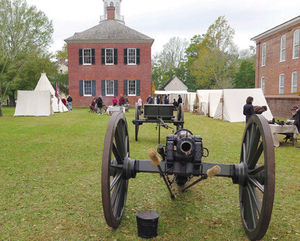
Civil War artillery and infantry can be seen as a part of Tyron Palace’s Civil War Living History Weekend, which will be held on Saturday and Sunday, Aug. 15 and 16. (Contributed photo)
Used as part of the Foster General Hospital during the Union occupation of New Bern from 1862-65, the academy will be home to re-enactors, artillery and infantry demonstrations and lectures throughout Civil War Living History Weekend.
There will be lectures on several Civil War topics like the Battle of New Bern, blockade runners, surgery during the war, women in the Civil War and Fort Anderson.
Speakers include Civil War historians, re-enactors, and professors like Grover Godwin, Dr. Chris Fonvielle, Lori Sanderlin, Tryon Palace assistant director LeRae Umfleet and more.
In addition to the special activities at the academy, Tryon Palace will hold Civil War-themed tours in the historic’s Dixon and Stanly houses and the Civil War-era Hay House will be open on Eden Street.
Saturday evening the artillery and infantry will move to the South Lawn of Tryon Palace for live, night firings at 9 p.m.
Sunday’s activities will begin with a period church service and continue with more artillery and infantry drills on the academy lawn.
In addition to the free outdoor activities, the New Bern Academy Museum will also be free and open to the public throughout the two days, which includes the exhibit Face to Face: Civil War Sketches and Stories. The New Bern Academy is at 508 New St.
For more information about this or future events, call 252-639-3500 or visit www.tryonpalace.org.