TEXAS: UT to Decide What to Do With Confederate Statues
On Monday a UT task force charged with how to handle Confederate statues on its Austin campus submitted their final report to University President Greg Fenves. There’s three statues: Jefferson Davis, Robert E. Lee, and Albert Sidney Johnston. All three men had significant roles during in the Confederate Army.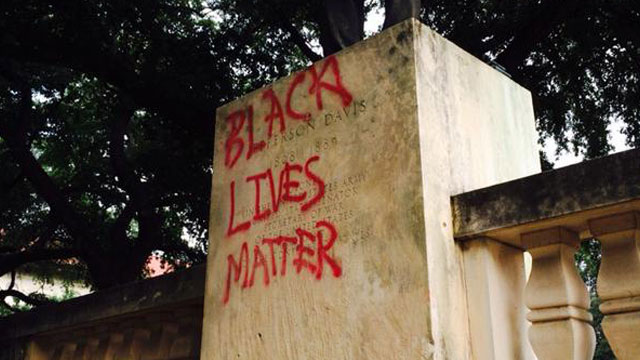
But some believe the statues represent an oppressive time in US history and should not be celebrated. The University hosted public meetings and students organized rallies to give their input. UT President Greg Fenves formed a task force to take public opinion and come up with various solutions.
The 12-member task force is chaired by Gregory Vincent, UT Vice President for Diversity and Community Engagement. It also includes other members of faculty, alumni and students.
The Task Force presented 5 options for Fenves to consider.
- Option 1: Leave all statues in place and add explanatory plaques that would enhance the educational value of the statues and provide historical context.
- Option 2: Relocate the statue of Jefferson Davis and the inscription near the Littlefield Fountain to an exhibit elsewhere on campus.
- Option 3: Relocate the statues of Davis, Robert E. Lee, Albert Sidney Johnston and John Reagan and the inscription near the Littlefield Fountain to an exhibit elsewhere on campus.
- Option 4: Relocate the statues of Davis, Lee, Johnston and Woodrow Wilson and the inscription near the Littlefield Fountain to an exhibit elsewhere on campus.
- Option 5: Relocate six statues — Davis, Lee, Reagan, Johnston, Wilson and James Hogg — and the inscription near the Littlefield Fountain to an exhibit elsewhere on campus.
Student Government suggested The University relocate the Confederate statues from the Main Mall to a museum.
“These statues were placed there by George Littlefield to show unity after World War One. He felt that brought together in unity the North and South, after lingering feelings from the war between the states,” said Marshall Davis, Sons of Confederate Veterans, Texas Division.
But others disagree.
“They are wrong, they are racist, they don’t need to be put in a museum because they will still be wrong and racist. They need to be destroyed,” said Mukund Rathi, a senior at UT Austin.
In June, someone vandalized the granite bases of the statues with spray paint. It’s since been cleaned up, but it’s further proof of how charged this issue is on the Austin campus.
–myfoxaustin.com
###
OKLAHOMA: Landowner Seeks Families of Civil War Soldiers
RINGWOOD, Okla. — In the middle of a farm, on one of Oklahoma’s many 100-degree days lay two Civil War-era tombstones. Unlike most tombstones, these are not visited every year. They simply are on a farm in Ringwood.
“My great-grandmother did the land run, and on the farm were these two headstones,” said Rod Bymaster. “My grandfather said they fell off of a cart. Then Jay’s dad bought the farm.”
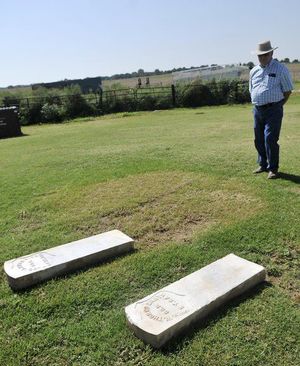
Rod Bymaster pauses next to two Civil War era tombstones found south of Ringwood. Bymaster and Jay Leierer want to locate family members of the soldiers and return the tombstones to them. Enid News & Eagle | Bonnie Vculek
Rod Bymaster pauses next to two Civil War era tombstones found south of Ringwood. Bymaster and Jay Leierer want to locate family members of the soldiers and return the tombstones to them.
Jay Leierer said his father used the tombstones as a landing for his steps to a trailer house.
“Two to three years ago, we tore the old trailer house down and the stones remained,” Leierer said.
“I thought if these belong to someone’s family they may want them back.”
The two tombstones read: W.M. W. Thornberry, CO. D., 3 Ky.Cav, and Thos. J. Hutchins, CO. H., 1 Ark.Cav.
Thornberry was in the 3rd Regiment Kentucky Cavalry, according to the tombstone. The Kentucky Cavalry served the Union Army during the Civil War. The cavalry was organized in Calhoun and McLean Counties in Kentucky for a three-year enlistment in 1861, according to The New York Times archive files.
According to a death record in Grant County, Ky., John William Thornberry served the 3rd Battalion KY Mounted Riflemen Company E. He died in Corinth, Ky., in 1905. He left behind his wife, Sarah Ann Thornberry, who applied for widower status and pension, according to county records. These records are no indication that the tombstone is John William Thornberry’s.
Hutchins was in the 1st Arkansas Cavalry, according to the tombstone. The Arkansas Cavalry Regiment served the Confederate States of America. The cavalry had many names since its inception in 1862, including Fagan’s Cavalry and Monroe’s Cavalry, according to the Official Records of the American Civil War.
Arkansas Research Inc. lists a Thomas Hutchins who served in the cavalry, but to find more details, the book must be purchased.
This is something Leierer said he runs into a lot.
“I researched the names and each time I got close, the website would ask for my credit card number,” he said. “Some Hutchins used to live south of here and a Thornberry north, but we don’t know if they’re connected. We want to find out where they (the tombstones) belong so we can go and deliver them to the families.”
Bymaster said he was thinking about the tombstones when he moved back from Michigan. He ran into Leierer at Vanessa’s Mexican Restaurant and they started to talk about finding the owners.
“I had already done some research a couple of months before, so when Rod (Bymaster) mentioned it, I knew exactly where to find my notes,” Leierer said.
In doing research, Leierer said he was surprised to find how many battles were fought in what today is considered Oklahoma. What surprised him even more was how many people came back to Oklahoma to settle after the war was finished.
Bymaster said just north of part of the farm is a cemetery, so he understands losing the stones on a horse-drawn carriage was plausible.
The tombstones are in near perfect condition, still white with little to no dirt stains.
“They stayed face-down for probably 50 years,” Leierer said. “My dad bought the farm in the late ’60s. Before that, they sat under a cedar tree.”
The two men want to find the families and owners of the stones out of respect for their service.
In the age of Civil War collectors and eBay, Bymaster and Leierer said they never wanted to sell the stones even though they could.
“They’re not mine, and they’re not mine to sell or give away,” Leierer said. “If they were my family members, I would want them back.”
Both stones have traveled five miles in the last 140 years to different areas on the farm.
“My grandfather left them because they weren’t bothering anyone and he couldn’t use them,” Bymaster said. “There was not Google back then.”
Both men hope exposure will help them find the owners or at least more history on the stones.
Anyone with information is asked to call the Enid News & Eagle at (580) 548-8163 or email[email protected].
–enidnews.com
###
VIRGINIA: Manassas Ladies Bring Battle to Life
Civil War Weekend is not just about fighting and strategy. It’s about the upheavals of lives and it’s about the lives of women during the Civil War.
Living historians will portray Clara Barton, the famous Civil War nurse; Dorothea Dix, an American activist who created the first American mental asylums; Elizabeth Keckley, Mary Todd Lincoln’s seamstress and confidante; the wives of Generals Robert E. Lee, Thomas “Stonewall” Jackson, and Isaac Trimble. Barbara Smith and Hendrina Appelt will speak to audiences about the role of women in the war.

Re-enator at Manassas.
Tracey McIntire and Dr. Audrey Scanlan-Teller will speak about the experiences of more than four hundred women who disguised themselves as men and served in the Union and Confederate armies during the Civil War. They will speak not only about individual soldiers, but about gender roles and military culture during the era.
Inside the Manassas Museum, join museum curator Mary Helen Dellinger for Chats with the Curator. These will highlight unusual items in the Museum collection. Prince William County Historic Site Operations Supervisor Rob Orrison will speak about the joint city-county exhibit, New World Aristocracy: The Carters of Virginia,and guest curator Chesney Rhodes will speak about her exhibit, Partisans Among Playmates: American Childhood and the Civil War.
At nearby Liberia Plantation, 8601 Portner Avenue, stroll through the shade-filled grounds and hear the accounts of well-known Confederate Spy Rose Greenhow, portrayed by Emily Lapisardi. A living historian who has presented historical impersonations in nine states and the District of Columbia, Lapisardi will tell the stories of Liberia’s connection to Civil War spy rings and Greenhow’s ability to glean information from Union admirers.
Interpreter Marion Dobbins will bring to life a more local slave experience as she presents a portrayal of slave life at Liberia, once the largest slave-holding plantation in the area. Dobbins will also cook over an open fire, and talk about African-American “foodways” and culture.
Check manassasmuseum.org/civilwar for the weekend’s latest schedule.
–potomaclocal.com
###
SOUTH CAROLINA: National Action Network Calls for Flag Removal From Town Sign
GOOSE CREEK, S.C. — The National Action Network made a second demand on Monday for a Confederate flag emblem to be removed from a sign in Goose Creek.
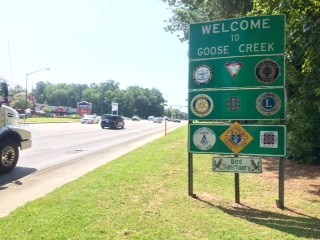 The emblem is sponsored by the Sons of Confederate Veterans.
The NAN says Goose Creek’s mayor has refused to meet with them on the issue.
A spokesman for Mayor Michael Heitzler says Heitzler is “standing pat” and will not have the emblem removed.
The National Action Network says it will attend Tuesday night’s city council meeting hoping to be heard.
“The semblance of that flag has killed so many of my people and that flag does not speak for me and doesn’t speak for the rest of those folks who are standing behind me. So as far as I’m concerned, it needs to come down,” Goose Creek National Action Network president Bryan Sharp said.
The NAN also is demanding a similar emblem to be removed in Mt. Pleasant.
State National Action Network President Elder James Johnson says town officials have agreed to meet with them this week.
–live5news.com
###