WASHINGTON, D.C.: National Cathedral Will Remove Confederate Flags From Stained Glass Windows
The Washington National Cathedral says it will remove two images of the Confederate battle flag from the building’s stained glass windows. Then the church will hold a period of public discussion on issues of race, slavery and justice and revisit the question of how to treat other depictions of the Civil War on the windows.
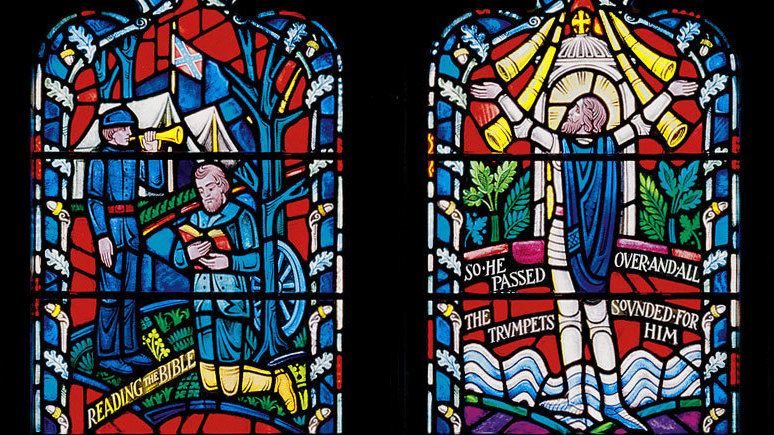
The windows twice feature the Confederate battle flag.
Courtesy of The National Cathedral
The windows in question memorialize Confederate Gens. Robert E. Lee and Stonewall Jackson; they were installed in 1953 after lobbying by the United Daughters of the Confederacy. They feature images from the lives of the two generals and include two Confederate battle flags.
A five-person task force that examined the windows’ symbolic power said the flags cannot remain on the cathedral as they have thus far in the building’s history. But instead of quietly taking down the windows, the task force said, just the flags should be replaced — and then the windows should be used as a starting point for a series of conversations.
“[T]he windows provide a catalyst for honest discussions about race and the legacy of slavery and for addressing the uncomfortable and too often avoided issues of race in America,” the task force found, according to a press release from the National Cathedral.
One member of the task force said the windows raise a question about race and slavery in America, “and instead of turning away from that question, the cathedral has decided to lean into it.”
A series of panel discussions and events exploring race and racism will kick off next month at the cathedral in Washington, D.C.
During the period of discussion, the windows as a whole will remain in place. But the Confederate flag images, specifically, will be removed and replaced with plain glass, a process that will be paid for by private donors, the cathedral says.
Within the next two years, the Cathedral says, the church’s leaders will revisit the question of how to treat the rest of the Confederate War-themed imagery on the windows.
(The press statement is unclear on the timeline for replacing the flags, but the cathedral confirms it is planned for the near future, compared with the two-year timeline for the rest of the windows.)
Last year, the Very Rev. Gary Hall, then dean of the cathedral, told NPR that it was time for the windows to go and announced that he had called on the cathedral leadership to start a process to do that.
–npr.org
###
GEORGIA: North Georgia Man Asked To Remove Confederate Display From Yard
LAFAYETTE, GA (Times Free Press) – A North Georgia man said he is being forced to remove a Civil War display from his front yard. Kevin Smith spent the last three years building the life-size display to depict battles fought on local soil. Now the Lafayette Housing Authority wants the display removed.
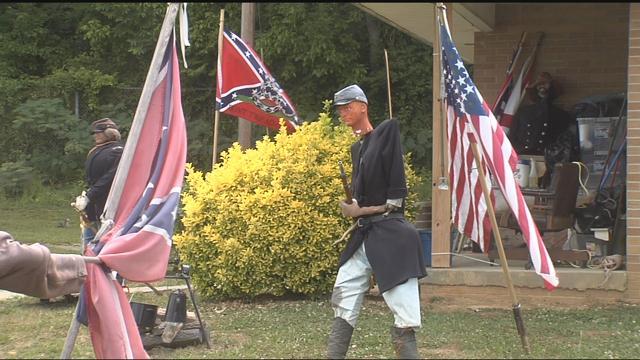
Offending Civil War display.
Kevin Smith said the mannequins and Confederate flags have been in his front yard for three years. He said he has no plans on taking them down.
Confederate flags and mannequins depicting Civil War soldiers fill much of Kevin Smith’s front yard. He said each model and flag represents a certain battle. Smith said it’s his way of educating his community. “Presentation. I tried to put the display around town so tourist can see the history and draw tourism here,” said Smith.
On Thursday, he received a notice from the Housing Authority saying the display “has to go” after complaints. “Complaints that the statues and confederate flag, and they would have to go.”
The notice cites complaints but does not say who filed those complaints. Smith can’t understand the problem. “Mowers can get in here, zero turn mowers. It is not blocking the mowers or trimmers.”
Channel 3 reached out to Housing Authority officials, who refused to comment — citing advice from their attorneys. A spokesperson said the authority is trying to work things out with Mr. Smith.
Smith says the Civil War played an important role in US and Walker County history. He doesn’t want those years to be forgotten. “I am standing my ground. This is a part of our history. It is to educate so we don’t fight another war.”
Smith said he has no plans to remove the display or leave his home. Based on the notice he was provided, it’s not clear when the display must be removed or what action the Housing Authority plans to take if it is not.
–wrcbtv.com
###
VIRGINIA: Hampton Group Transforms First Civil War Battle Field
HAMPTON, Va. — When two local historians began looking for ways to commemorate the site of the landmark June 10, 1861 Battle of Big Bethel, they knew they faced some problems.
Just finding the old United Daughters of the Confederacy marker from 1964 proved elusive until Sherry Greshamer crossed old Big Bethel Road, hopped a ditch and peered into the brush that obscured its lost location behind a chain-link fence.
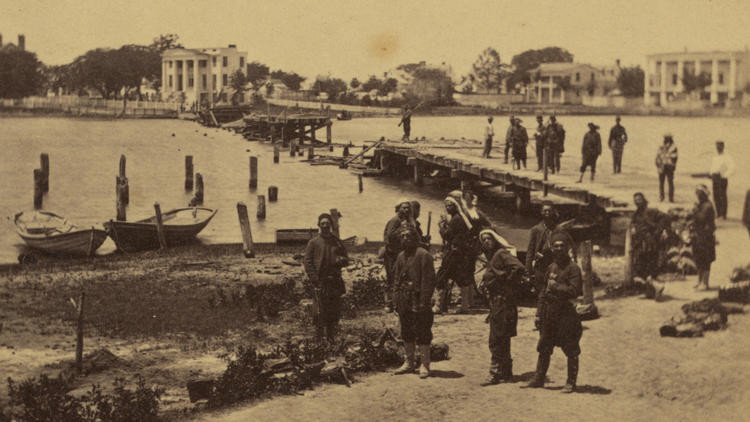
Just 15 days after rushing by steamer to Fort Monroe, the newly formed 5th New York Volunteers — also known as Duryee’s Zouaves — played a leading role in the first land battle of the Civil War, launching two valiant charges against vicious Confederate defenses at Big Bethel. These images recall the unit’s distinctive French-inspired uniforms and tent life at Camp Hamilton as well as the landmark battle. Click here for the 2011 150th anniversary story. — Mark St. John Erickson
Then there was the tiny parcel of land that remained nearly 150 years after the clash — and which was crisscrossed with fallen trees, impassable undergrowth and cast-off junk ranging from barbells to an abandoned boat trailer, Christine J. Gergely recalls.
But nearly a decade after they started, the site of the Civil War’s first land battle has been so transformed it will be dedicated as The Battle of Big Bethel Walking Park.
Relocated in 2014, the Confederate monument now stands just yards away from a new tribute to the Union cause, which was erected in 2011 with donations from the pair’s Bethel UDC chapter as well as Civil War enthusiasts in New York, Vermont and North Carolina.
Ten new Civil War Trails markers funded by the Hampton Convention and Visitor Bureau guide visitors on a walking tour, using 40 period images to recreate a clash that so shocked the people of North and South with its mayhem and blood that newspapers of the day compared it to Wellington’s victory — and Napoleon’s loss — at Waterloo.
“Big Bethel has been overlooked — and little has been done to preserve it until now,” says historian John V. Quarstein, who raised funds for the park.
“But this was the first time the men of the North and South stood up and fired at each other in a planned and prolonged engagement — and it changed everybody’s idea of what the war would be like.
“All the eyes of the nation were focused right here on the Peninsula.”
Milestone clash
Located at a strategic point on the old road from Yorktown to Hampton, the ridges surrounding Big Bethel Church attracted attention from North and South during the early months of the Civil War, leading to a Confederate fortification and a Union attack 155 years ago today.
The soldiers in gray dispatched from the main defensive line at Yorktown numbered about 1,400 — while the two Federal columns from Camp Hamilton outside Fort Monroe in Hampton and Camp Butler in Newport News mustered about 4,000, says city Historian J. Michael Cobb, co-author of “Battle of Big Bethel: Crucial Clash in Early Civil War Virginia.”
Despite being outnumbered, the Confederates repulsed three valiant if ultimately unsuccessful attacks by the Union men in a prolonged 4-hour battle.
“The Southerners built a massive fortification around the church and on the other side of Brick Kiln Creek — and that proved to be crucial,” Cobb says.
“When the Union got here, the whole landscape erupted with artillery and musket fire — and though they were very brave in their attacks they quickly learned that no troops could charge fortifications like these and do well.”
Soon afterward, the men of the 1st North Carolina Volunteer Infantry took on the honorary title of “Bethel Regiment” for leading the South’s triumph.
Though their opponents from New York, Vermont and Massachusetts retired from the field bloodied and embarrassed, every Union soldier recognized the historic significance of the clash, including the engineer who sketched the abandoned Southern defenses when the Army of the Potomac marched up the same road toward Yorktown nearly a year later.
Since then, most of the battlefield has given way to development, including not only the convenience store erected on the site where the first West Point graduate was killed during the war but also residential tracts and a reservoir that flooded all but the southernmost portion of the Confederate earthworks.
“Everyone used to say the battlefield was underwater, but the forward gun position on the Hampton side of the creek sat at the highest position on the battlefield — and it’s still there,” says Quarstein, author of “Big Bethel: The First Battle.”
“This was the hot spot of the battle — it’s where most of the casualties fell — including the first Confederate killed in battle during the war.”
Honoring history
Southerners began erecting monuments here in 1905, including not only a marker honoring the memory of the first fallen Confederate — Henry Lawson Wyatt — but also the stately obelisk that stands in the old church cemetery on the other side of the reservoir.
The UDC dedicated its tribute in 1964, says chapter president Gergely, who also is a long-time supporter of the city’s history museum.
But when she and Greshamer launched their project to raise the site’s profile nearly a decade ago, there was little to distinguish it from the adjacent campground and woods owned by Langley Air Force Base.
“I remember the first time I went to the site,” says Convention and Visitor Bureau chief Mary Fugere.
“I would never have known something significant had occurred.”
That anonymity began to change with a massive clean-up and the first Civil War Trails sign.
Then there was the 2011 dedication of a new monument honoring the Union soldiers who took part in the battle, followed by the relocation of the UDC marker in 2014 as a Confederate bookend.
“We wanted to tell the stories of both sides,” Greshamer says, describing how the descendants of the South joined their Northern counterparts to help pay for the new stone.
“This is our history, too, and the first flag we put out when we come here is the American flag.”
Nine more Civil War Trail signs were completed earlier this year as part of a new walking tour that describes not only the fighting but also its prelude, the stories of various participants from both North and South and its aftermath.
But more work remains to be done clearing away the poison ivy that obscures the last remnant of the Confederate earthworks and installing a bench for visitors who want to sit and imagine its fiery day of battle.
“You’re talking about women 59 to 69 years old coming out and putting down mulch — and the trail is much improved,” Gergely says.
“But there’s still a lot to do.”
–dailypress.com
###