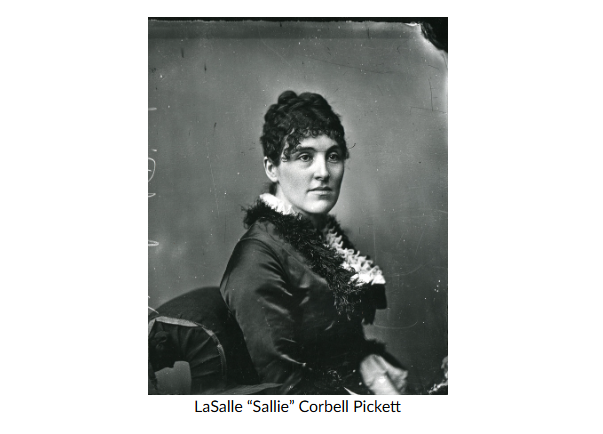
LaSalle Corbell Pickett is arguably one of the great storytellers and mythmakers in American history. This reputation can be attributed to the inconsistencies and fabrications of evidence that appear in her biographies of her husband.[1]
George Pickett’s reputation is a mixed one in the eyes of history. Some of his peers viewed him as the source of the army’s failure at Gettysburg and Five Forks.[2] Others recalled that he did well in a terrible situation and credit him for saving the Army of Northern Virginia on the retreat from Gettysburg.[3] Pickett’s place in history is complicated by Sallie writing and publishing her husband’s memoirs. Where Pickett, the man, stops and Sallie’s romantic ideal starts is the question left for us to figure out.
In the decades since the war ended, Pickett has been considered among Lee’s worst division commanders by many students of the conflict. Following his promotion to major general in 1862, he only commanded his division in battle three times at Gettysburg, New Bern, and Five Forks. J.S. Mosby recounted that Gettysburg and Five Forks were the sources of Pickett’s reputation being so low after the war.[4]
In most narratives, the story ends here, with Pickett viewed as another John Pemberton or John Bell Hood who was advanced beyond his capabilities. Thanks to his wife, Pickett is not like most mediocre generals. LaSalle Pickett ensured that her husband, in death, became the romantic warrior the couple fancied him to be. No longer the failure of Gettysburg and Five Forks, he is remembered for that one fleeting moment where the story could take a different turn, that moment when Lewis Armistead’s brigade penetrated the Union line at the Angle and nearly fulfilled Lee’s audacious vision.
Sallie Pickett devoted the rest of her life to protecting, or rather fabricating, the legacies of Pickett and his division. In her biography, we get the first account of Pickett’s animosity toward Lee for Gettysburg. This is the most in-depth version of the bitter postwar reunion between Lee and Pickett, and we see Pickett portrayed as the champion of Southern chivalry. Sallie herself wrote at the end of her biography that “if promised supports had materialized the attack” at Gettysburg “would have been successful.”[5]
There is little doubt that Mrs. Pickett fabricated her husband’s memoirs. Heart of a Solider, the letters she claims George sent her during the war, include many instances of word-for-word extracts from the writings of James Longstreet, E. Porter Alexander, and Walter Harrison.[6] This can be as innocent as her interviewing the same witnesses and writing from the same sources
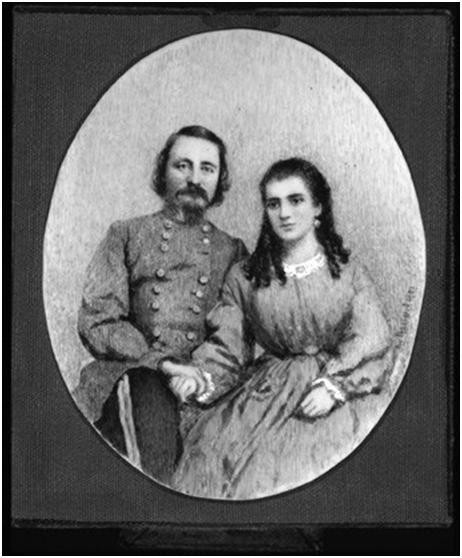
Far more likely is that she blatantly plagiarized from the writing of these three men. There are two smoking guns to this argument. The first is how Pickett concludes the letters: George chooses to sign off “your soldier,” which matches how Sallie referred to him.[7] In letters that we can verify George wrote, he opted to sign with his name. Editing the ending itself does not prove fabrication and could be explained as artistic license to fit her book’s tone. The problem lies in how she chose to edit the content of the letters. Several letters written during the Gettysburg campaign are pages long and contain information that no officer would put to paper on enemy soil.[8] While the letters contain no falsehoods, it is almost certain that George told Sallie about the contents later, and she wrote them as if they had been in the letters he sent her. In a letter that we can verify from the timeframe around Gettysburg, Pickett explained to his wife that he would write more than a page or two, but the lines of communication were so long that he had doubts that they would safely reach Virginia without the Union intercepting them.[9]
Why, then, if it is so easy to tell that the letters are fake, were they taken as truth for so long? The answer is quite simple: James Longstreet and E.P. Alexander, two of the men she had plagiarized, penned endorsements for the book. In all likelihood, they did this without reading the contents. Another factor is that by this point, the Lost Cause movement was in full swing, and anyone associated with the Army of Northern Virginia was undergoing a renaissance in the eyes of history. The last reason is the least interesting: Publishing houses saw a good story and did not think Sallie would go through the trouble of fabricating so many lengthy letters.
The second question that must be considered is why she fabricated so many letters. Gary Gallagher argued that the answer was monetary. Pickett did not prosper in his professional ventures after the war, and it is likely that Sallie needed the money and knew that a memoir of her husband’s, even a fake one, would sell well.[10] However, her motives seem even more selfish than survival; her vanity required it. Sallie relished the attention that came with being the widow of one of Lee’s generals. In Lost Cause and literary circles, she was known as the “Child-Bride of the Confederacy.” Many of the fabricated letters place her at the center of the narrative. One of the popular stories she tells in her account is the falling out between her husband and Lee after Gettysburg, going as far as to provide details of a tense 1868 reunion.

In Sallie’s telling, Pickett left the meeting and angrily told J.S Mosby that Lee had ruined him at Gettysburg. While Mosby does verify this, quoting George as saying, “That man ruined my division at Gettysburg.”[11] All in attendance recalled the last meeting as cordial and respectful between the two men. Nonetheless, this story has become apocryphal in many accounts of Lee’s postwar life. However, Mosby and other eyewitnesses recalled that Pickett’s anger was instead over his treatment by Lee and his former aide-de-camp Walter Taylor following the disaster at Five Forks in the war’s closing days.[12] The war itself is the strongest evidence that Five Forks was the moment Pickett and Lee saw their relationship sour. Lee did not relieve Pickett after Gettysburg despite a history of dismissing officers who had failed at far less critical assignments. Instead, Lee shouldered the blame and retained Pickett, even entrusting him with the key position at Five Forks. Instead, Lee blamed himself for the failed charge and retained Pickett.
Ultimately this fact was lost in Sallie’s version of the relationship between Lee and her husband. Sallie’s vanity and narrative needed a scapegoat to deflect the blame from her husband. Her narrative of a misunderstood Confederate war hero could not hold water without a villain in the story. Protecting George’s legacy required that she go back to the tool she used countless times before, her fabrications. She blamed officers who had already died for her husband’s shortcomings. These attacks showed another element of Sallie’s psyche: she needed to discredit her husband’s detractors and cast blame for the outcome of the war entirely on their shoulders.
Lucas Simmons holds a B.A. in history from Southern Virginia University and an M.A. in history education from Grand Canyon University. He enjoys learning about the Civil War, especially the Valley and Overland Campaigns. When he is not glued to a book or writing project he enjoys swimming, hiking, and giving tours of his native Shenandoah Valley.
–emergingcivilwar.com
Endnotes:
[1] Gary Gallagher, Lee and His Generals in War and Memory, (Baton Rouge: LSU Press, 1998):228.
[2] E. Porter Alexander remarked in a letter to Longstreet that Pickett’s Charge failed only because Pickett was too cautious in his movement toward Cemetery Ridge.
[3] Walter Harrison, Pickett’s Men: A Fragment of War History (Baton Rouge: LSU Press, 2000): 95-108.
[4] John Singleton Mosby, The Memoirs of Colonel John S. Mosby (Boston: Little, Brown, and Company, 1917), 381-382.
[5] LaSalle Corbell Pickett, The Heart of a Soldier: As Revealed in the Intimate Letters of Genl. George Pickett CSA (New York: Seth Moyle, 1913), 212.
[6] Gallagher, Lee and His Generals, 227-241.
[7] Ibid, 238; Pickett, The Heart of a Solider, 80.
[8] Letters Sallie claims to have received during the Gettysburg campaign are 2-5 pages long and contain information that George would have known not to put to paper while on the campaign. In another instance, during the retreat, a letter references the death of General Lewis Armistead on July 4. In their writings about the campaign, Walter Harrison and James Longstreet disclose that they did not learn of Armistead’s death until they had returned to Richmond.
[9] Gallagher, Lee and His Generals, 240.
[10] Ibid, 241.
[11] Mosby, The Memoirs of Colonel John S. Mosby, 381.
[12] Ibid, 381-382.