
Three years of planning and fundraising to commemorate an obscure but major piece in America’s 250th celebration was wiped out in just three days.
The story starts before the American Revolution. The British built Fort Bute at the confluence of Bayou Manchac and the Mississippi River in 1766, exactly 10 years before the signing of the Declaration of Independence in the Pennsylvania State House, now known as Independence Hall.
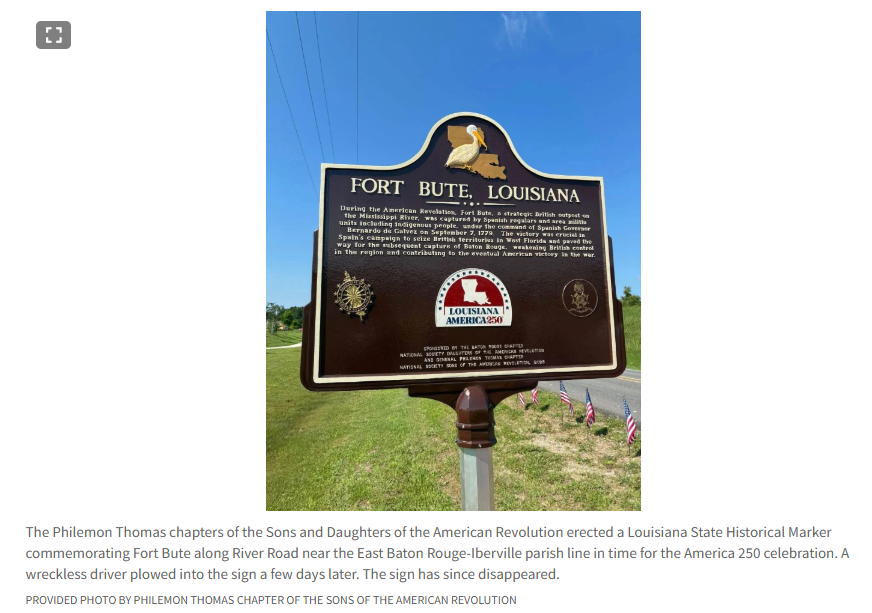
The Baton Rouge Chapter Louisiana Society of the Daughters of the American Revolution and the General Philemon Thomas Chapter of the Sons of American Revolution spent three years researching and fundraising to install the historical marker near the site of the British’s Fort Bute in the southernmost corner of East Baton Rouge Parish.
The sign, erected on May 30, was set to stand just in time for America’s 250th celebration. And the timing was important, because the 1779 battle that played out at Fort Bute was a pivotal point in the American Revolution.
Important British post
Fort Bute was an important strategic post for the British, not only for defense but shipping and trade, and with subsequent forts along the Mississippi River in Baton Rouge and Natchez, they were well entrenched.
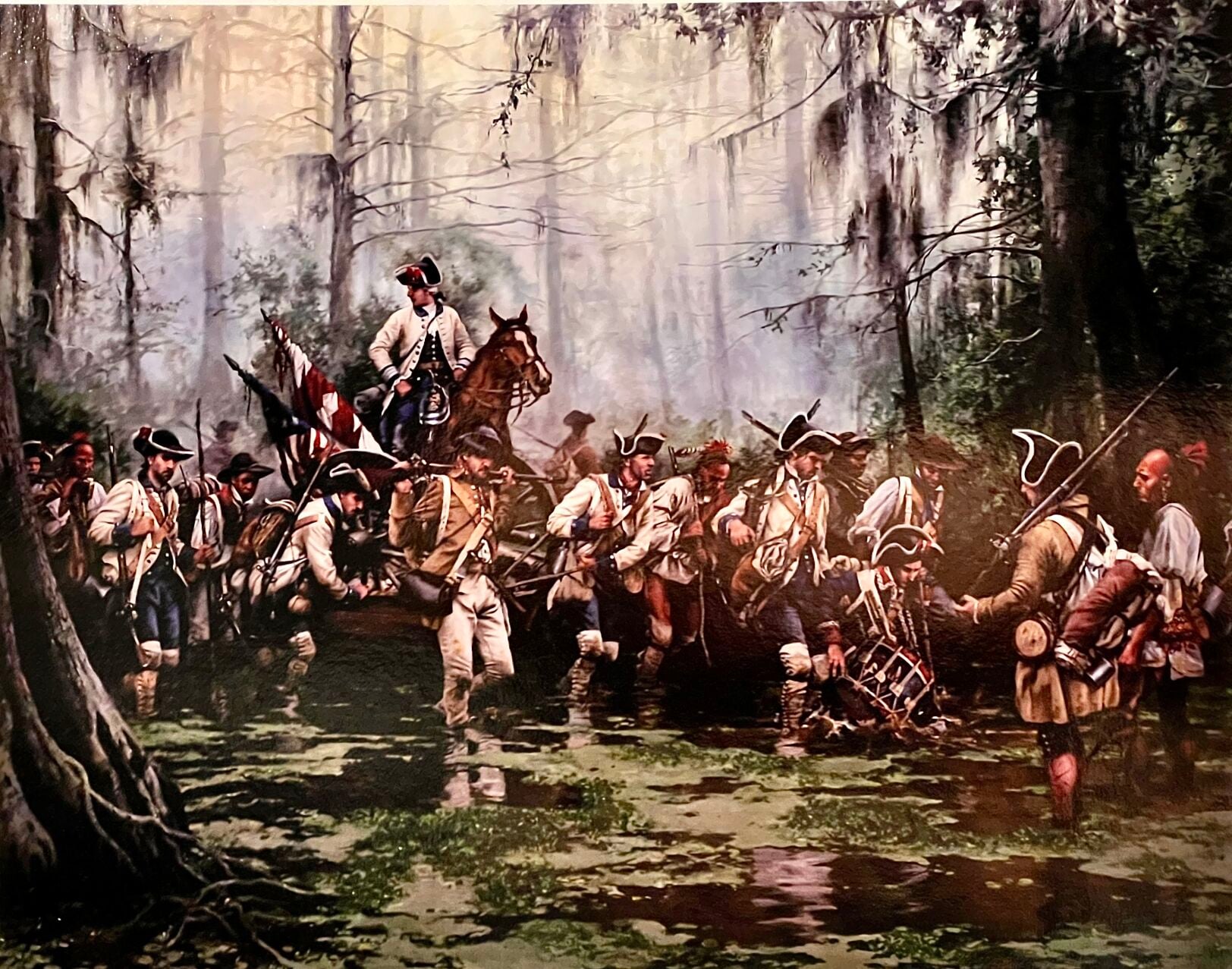
That is, until Spain’s colonial governor for the Louisiana territory Bernardo de Galvez, and his mixed ethnic collection of 1,400 Spanish, Acadian and German troops marched from New Orleans to stage an attack on Sept. 7, 1779, and sent the British army running to Baton Rouge.
Today, most drivers along River Road would never know that a fort filled with red-coated British soldiers once stood at the East Baton Rouge-Iberville parish line. Which is why the local chapters of Sons and Daughters of the Revolution spent three years raising more than $4,000 for the historical marker’s creation and installation.
The sign not only concisely told the story of what happened at the site but also included the “America 250” logo.

“Between May 30 and June 2, a careless driver plowed straight into the marker and destroyed it,” said Paul Bledsoe, secretary for the Sons of the American Revolution chapter.
The marker has since disappeared. Bledsoe said the two chapters aren’t offering a re
“Right now, we’re working on getting the driver’s insurance company to compensate the cost of the sign,” he said. “And we’re working with the state and the City of St. George on getting it replaced.”
The chapters received the sign last September, but there was some confusion as to who would be responsible for installing it — the Louisiana Department of Transportation and Development or the City of St. George.
“The stretch of the River Road from Gardere Lane to the Iberville Parish line, which is about 2½ miles, changed from state ownership to ownership by the City of St. George,” Bledsoe said.
But the chapters’ initial agreement for the installation process was made with the state, which eventually placed the marker.
“I believe that through working with the state, the marker will be replaced,” Bledsoe said.
Importance remains
Still, the sign’s absence devalues neither the organizations’ effort commemorating the site nor the story of what happened there.
Bledsoe said people have been talking about putting a marker there for years.
“But until recently, the evidence that is necessary to prove the fort’s location wasn’t easily available,” he said.

Rose Meyers’ 1976 book, “A History of Baton Rouge, 1699-1812,” is an often cited source for the Fort Bute story. Meyers was the head librarian for the East Baton Rouge Parish Library’s Downtown Branch, now called the River Center Branch.
Her book was published by LSU Press for the Baton Rouge Bicentennial Corp. and includes chapters chronicling Louisiana’s capital city under both British and Spanish rule, beginning with King George III’s proclamation of Great Britain’s 1763 takeover of West Florida following the French and Indian War.
Meyers writes that the British anchored their frigates there until they could build a “strong new fort in West Florida.”
Fort Bute also became important in Britain’s defensive strategy.
“Engineer Archibald Robertson supervised the planning and construction of Fort Bute, which consisted of a ‘blockhouse with a small stockaded fort,'” Meyers writes. “It housed 50 men and one officer, but, in an emergency, it could be made to accommodate 200.”
Named for British earl
The fort was named for John Stuart, 3rd Earl of Bute, who served as prime minister of Great Britain under King George III from 1762-63, and while the British were establishing trade dominance, the Americans tried but failed to persuade West Florida to join their cause.
The British sent more troops to Fort Bute and their other fortified posts at Baton Rouge and Natchez, establishing a blockade on the river.
In 1779, Meyers points out, though Galvez was young, he proved to be a competent governor for Spain, having anticipated impending war and striking first by marching his troops from New Orleans up the Mississippi River in August, with relentless sun, thick humidity and merciless insects.
French artist Augusto Ferrer-Dalmau offers what is considered one of the most realistic depictions of Galvez and his troops tromping through a swamp in his 2018 painting, “La Marcha de Galvez.”
Closer to home, late Baton Rouge sculptor Frank Hayden created a more impressionistic view of the same scene in his bronze “Marcha de Galvez,” fountain in Galvez Plaza at North Boulevard Town Square.
Both artworks tell the story of the troops who arrived at Fort Bute on Sept. 6, then attacked at dawn on Sept. 7, forcing the British’s retreat to Baton Rouge. The British surrendered to Galvez on Sept. 21, 1779, at the Baton Rouge fort.
The marker stood for three days. The site of Fort Bute is unmarked again.
To contact the General Philemon Thomas Chapter of the Sons of the American Revolution with any information about the missing marker, visit lassar.org/general-philemon-thomas/ or email [email protected].\
–theadvocate.com