MISSISSIPPI: Ole Miss Students Reject State Flag
The University of Mississippi, founded in 1848 in Oxford, is a school steeped in Southern traditions – some of them racist. When the South went to war, much of Ole Miss’s student body joined the Confederate cause in a fabled company known as the University Greys. When the school’s first black student was admitted in 1962, riots broke out. The campus is awash in tributes to the rebels – a Confederate Drive, a Confederate cemetery, a Confederate memorial and, until 2010, a mascot called “Colonel Reb.” It is, after all, the University of Mississippi.
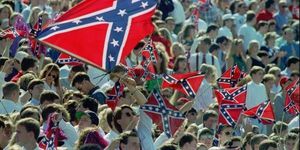
Students wave rebel flags.
But Tuesday night in a dramatic vote, Ole Miss student legislators moved to distance themselves from their state’s past and present. The school’s student senate approved a resolution asking the university to stop flying the Mississippi state flag, which includes a Confederate design, on campus grounds. And, though the resolution is non-binding, it puts a question to university officials much of the country has struggled with after a white supremacist allegedly killed nine churchgoers in Columbia, S.C., last summer: Is it still OK to embrace the stars and bars?
“I think it shows that we as a student body recognize that these symbols of white supremacy have no place on our campus,” sophomore and student senator Allen Coon, a 20-year-old major in public policy and African American studies who introduced the resolution, told The Washington Post in a telephone interview. “They affect people that are marginalized. They make students feel excluded on their own campus and they promote ideals of hate and racial oppression.”
The resolution, which passed 33-15-1 by the Daily Mississipian’s reckoning, condemned Mississippi’s flag in no uncertain terms. The flag is “the only state flag in the nation that incorporates the Confederate battle flag in its design,” it said; the flag “divides our campus and state” and “undermines efforts to promote diversity and create a safe, tolerant academic environment for all students”; and the flag “violates the UM Creed, which calls for ‘respect for the dignity of each person.'” Its removal “would advance the university’s efforts to create an inclusive space for all students.”
“Do not celebrate this decision simply because it is ‘making history,'” student body executive officers said in a statement after the vote, “but celebrate because this is a step in a direction that will fundamentally change the way we interact with one another, interacting under a unified banner that shows this world the true colors and best values Mississippi had to offer.”
Not everyone, however, supported the change.
“To live in a free society, the possibility to be offended will occasionally occur,” on online petition defending the flag circulated by student senator Andrew Soper ahead of the vote read. “Removing symbols, flags, and monuments will do nothing to change the way people feel in their hearts. . . . Ole Miss Students and my fellow Mississippians, rise up and push back on political correctness and support the state flag.”
In an anti-flag rally last week, students who wished the flag to be removed were confronted by their opponents, including members of the Ku Klux Klan.
“Black lives don’t matter,” KKK member Shaun Winkler said. “We are the blood of conquerers.”
“We can fly our flags where we want and how we want,” one man holding a Confederate flag and a sign reading “secede” said at the rally. When an onlooker said he was racist, the man said: “Absolutely.”
The resolution now goes to university officials, who were not immediately available for comment, for approval. But whether or not it is approved, student activists see the battle over the flag as just another step in reclaiming their school from the Old South.
“It is not for me to decide whether or not Confederate soldiers deserve glory,” Sierra Mannie of the Daily Mississippian wrote in Time last year, “but I do know that it is not the responsibility of an educational institution and its students to maintain the last bastion of the Confederacy, or to stand as a symbol of the ‘Old South,’ a period of assumed refinement and class that would maybe seem more romantic if it hadn’t all been built on the backs of slaves. Ole Miss has spent too long marinating in such an idyll.”
“This is the first step of many,” student senator Coon said. “Our campus rife with Confederate iconography. We intend to address these symbols in the coming months.”
Even the nickname of the university may be fair game.
“I avoid using the term ‘Ole Miss’ at all times,” Dominique Scott, an undergraduate in sociology and African American studies, told Democracy Now. “The term “Ole Miss” is definitely steeped in a history of racial oppression. Historically, the term “Ole Miss” is a term that slaves used to refer to the mistresses and/or matriarchs of their plantations.”
Some, however, think the university has come quite a ways already. In 1999, professor emeritus David G. Sansing, in his sesquicentennial history of the school published by the university’s press, called such controversies over symbols “recycled.”
“No collegiate institution in America has been more open and honest about its racial problems or as earnest in its efforts to resolve them as the university of Mississippi,” Sansing wrote. “Despite the discourse and distractions over symbols, and the burden of its history, Ole Miss has made remarkable progress.”
–newsandtribune.com
###
VIRGINIA: Civil War Trust Trumpets Virginia Campaign Success
CULPEPER, Va. (AP) — The Civil War Trust says a $3.6 million fundraising campaign has preserved 56 battlefield acres of Fleetwood Hill at Brandy Station, where more than 20,000 cavalrymen fought in the largest battle of its kind in North America.
The trust announced the conclusion of the campaign Monday at the Culpeper County battlefield. The acquisition, restoration and installation of an interpretive trail was achieved with private donations and matched with grants from state and federal battlefield protection programs.
The battle of Brandy Station was fought June 9, 1863, and was the opening struggle of the Gettysburg campaign.
Trust President James Lighthizer said the nonprofit preservation group has saved more land at Brandy Station than at any other battlefield in the country.
–Associated Press
###
NORTH CAROLINA: Fight over Silent Sam Statue Continues
The pick-up trucks and cars adorned with Confederate and American flags flapping in the air were hard to miss as they rolled down Franklin Street.
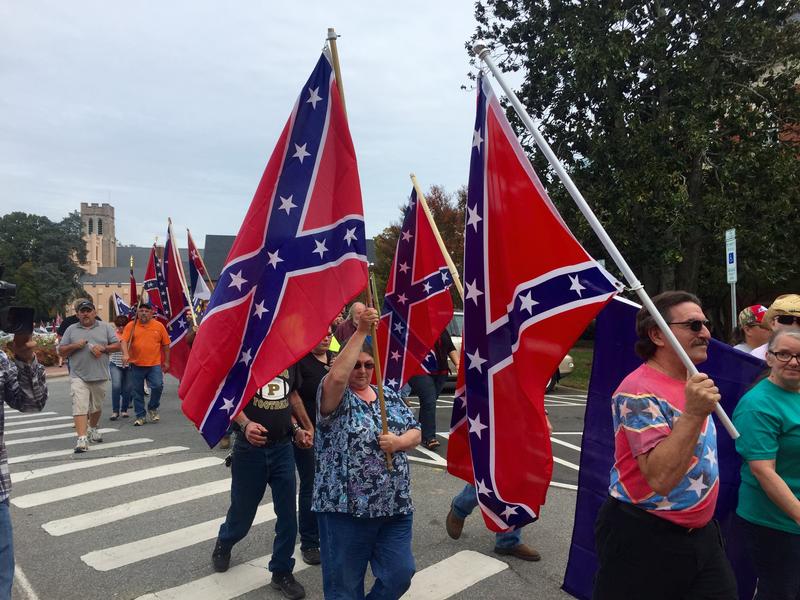
A group of people in support of a UNC Chapel Hill statute that honors confederate soldiers rallied on the campus Sunday, clashing with a counter-protest of largely college students.
As the caravan came to a stop, one woman got out of her truck with a flag wrapped around her waist. Others sported rebel caps and Confederate t-shirts.
“When we get up there, we’re going to stand together and we’re going to form a circle around [Silent Sam],” said organizer Gary Williamson.
In a parking lot, dozens of protesters nodded their heads as Williamson went over the game plan and reminded them why they are there. Williamson is part of a group called “Alamance County Taking Back Alamance County,” which aims to preserve Southern rights, according to the Facebook page.
“Them men died and this school ought to stand up for the monument up there cause this is part of their history too. These are the men who died from their school,” Williamson said. “Why they would not honor that, I don’t know.”
Williamson is talking about a bronze 1913 statute called “Silent Sam.” It sits on one of the most visible lawns on campus and honors UNC alumni who fought and died in the Civil War.
But not everyone sees that heritage as honorable. Earlier this year, the statute was vandalized with the words “KKK” and “Murderer.” To many students, the statue of the confederate soldier raising a gun is a symbol of white supremacy. And they made it clear to the people quietly marching toward the statue, with confederate flags in hand.
“Go home. We hate you. Go home,” yelled one man, who didn’t give his name and shouted profanity.
As they get closer, the group was met with more angry protesters. A lot more.
“Hey, hey. Ho, ho, this racist statute has got to go!” a group of community members and students shouted.
The statue was barricaded by metal fences that separated the two groups on either side. Dozens of police officers stood guard. On one side, they sang Dixie. On the other, chants like “Black people built the South.”
Silent Sam supporters like Gary Williamson scoffed. He said his ancestors fought for freedom.
“There are so many things that we fought for that had absolutely nothing to do with racism or slavery,” he said. “And they have no idea or anything about that. They go on propaganda websites off of Facebook or whatever, and stuff like that, and they get mad and stomp their feet,” he said.
“If there’s one thing racists love, it’s to be heard, even if they’re wrong,” said Leah Osae, a first-year UNC pharmacy student and one of the main organizers of the counter-protest.
She said Silent Sam needs to go.
“It will come down, eventually, and they know that,” she said. “That’s why they’re coming here.”
The legislature recently passed a bill that would make it harder to get rid of statutes and memorials. Silent Sam has been the target of many demonstrations by students who argue they haven’t felt supported by the administration.
“It’s regretful that that’s the way that they perceive things,” said Winston Crisp, vice chancellor for student affairs.
He says several UNC staff members were present to make sure protesters felt safe, and that he understands the monument is divisive.
“And there are lots of different viewpoints, and at a public university all of those viewpoints get to be aired,” he said.
A little later in the afternoon, a few counter-protesters made their way to the other side of the monument to confront demonstrators carrying Confederate flags.
Several of them got into heated debates over history, the confederate flag and white privilege, while others tried to see eye-to-eye.
UNC senior Angel Joel said she was tired of hearing people shouting over each other, so she talked with William Allen, a monument supporter from Chapel Hill, to hear what he had to say.
“Racism has come to mean when somebody is being proud of being different by their race, that all of a sudden is racist,” Allen explained to her.
Even though Joel didn’t entirely agree with his perspective, they engaged in a brief conversation about white privilege.
“I can see [the statute’s] place here because it does start good conversation about the history of UNC, but I can also see its place in a museum,” Allen said.
The protesters supporting Silent Sam stayed at the statute for about three hours debating and talking with students. When they decided it was time to go, some of them took one last look at the monument and saluted.
–wunc.org
###
MAINE: Bowdoin College Ends Confederate Heritage Award
Bowdoin College has ended an academic award named and financed by a Confederate-pride group, abandoning its earlier defense of an honor similar to many that continue to be offered by U.S. military-service academies.
Bowdoin’s Board of Trustees voted to cease giving an academic award named for Jefferson Davis, the president of the Confederacy, and to return to the United Daughters of the Confederacy endowment funds used to finance the decades-old prize, the Maine college announced last week. In the college’s statement about its decision, Clayton Rose, its president, said, “It is inappropriate for Bowdoin College to bestow an annual award that continues to honor a man whose mission was to preserve and institutionalize slavery.”
All five of the nation’s service academies continue to offer annual awards financed by the United Daughters of the Confederacy, and, in several cases, named for famed Confederate officers. They include a Robert E. Lee award for systems engineering awarded by the U.S. Military Academy, physics-related awards in honor of Commodore Matthew Fontaine Maury given by the U.S. Naval Academy and the U.S. Merchant Marine Academy, and an Adm. Raphael Semmes award for applied science given by the U.S. Coast Guard Academy.
The United Daughters of the Confederacy has drawn controversy for, among other things, continuing to espouse a revisionist account of the Civil War that it teaches to members of its auxiliary for children. The website of its South Carolina chapter, for example, features a creed for members of Children of the Confederacy in which they pledge to study and teach “that the War Between the States was not a rebellion, nor was its underlying cause to sustain slavery.”
When the United Daughters of the Confederacy sued Vanderbilt University over its 2002 decision to remove the word “Confederate” from the stone front of a dormitory that the UDC had helped finance, it emerged in court proceedings that a document used to teach Children of the Confederacy stated that slaves in the South “were treated, in most cases, with kindness and care,” and mostly were “faithful and devoted” and “usually ready and willing to serve their masters.”
In a 2011 petition to the White House urging President Obama to put an end to the U.S. service academies’ awards financed by the United Daughters, Edward H. Sebesta, a Texas-based historian, argued that some of the Confederate officers honored by the awards were “notorious racists.” Among them, Raphael Semmes, for whom the Coast Guard’s award is named, in 1863 erected a mock tombstone to Abraham Lincoln saying that president had died of “nigger on the brain.” In an interview this summer, Mr. Sebesta said he had never received any response to his petition.
Asked last summer for comment on the little-known service-academy scholarships, the White House and the Pentagon directed inquiries to the service academies, whose spokesmen described the awards as noncontroversial and among hundreds annually given out. The United Daughters of the Confederacy refused repeated requests for comment or background on the awards or its teachings to children.
Bowdoin’s decision to end its Jefferson Davis prize occurred just months after Scott Hood, its spokesman, said the college had no plans to reconsider the award, established in 1972 and presented annually to a student excelling in constitutional law. In a June email to The Chronicle, Mr. Hood said Jefferson Davis received an honorary degree from Bowdoin in 1858, before the outbreak of the Civil War, when he was a U.S. senator from Mississippi.
“After the war, there were calls to rescind Davis’s honorary degree, but the college did not do so, arguing that it had been awarded before the war and that his ‘later conduct had no bearing on the matter,’” Mr. Hood said in his email. He said he could not recall any recent controversy over the award or the United Daughters of the Confederacy in financing it.
Nearly 290 Bowdoin alumni fought for the Union, according to the college, and among them was Joshua L. Chamberlain, a professor and later president of Bowdoin who was a hero at the battle of Gettysburg and who commanded the Union troops who received General Lee’s formal surrender at Appomattox.
–chronicle.com
###