TENNESSEE: Perspectives Clash at Racial Forum
MTSU students, most of them black, demanded the name of Confederate Gen. Nathan Bedford Forrest be removed from the university’s ROTC hall, some calling it “institutionalized racism” at a Tuesday forum.
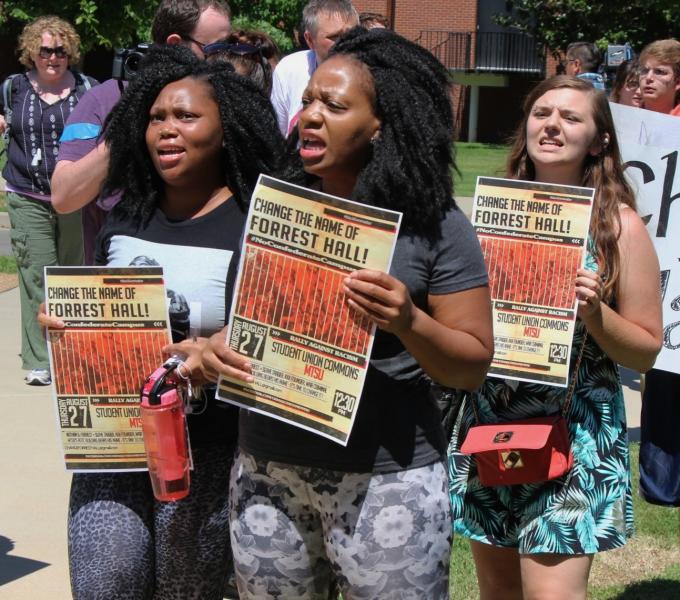
Students protest at a rally this past August. JOHN BUTWELL/The Murfreesboro Post
“Every day I walk past a building named for a man who traded, sold and killed my ancestors,” said MTSU student Arin Cooper, making note of Forrest’s pre-Civil War occupation in the slave trade and post-war connection to the Ku Klux Klan.
Speakers made their points before the university’s Forrest Hall task force appointed by MTSU President Sidney McPhee to make one of three recommendations by April: Change the hall’s name, maintain it with a historical explanation or take no action. The president could follow up with a proposal to the Tennessee Board of Regents, and the matter would be considered ultimately by the Tennessee Historical Commission.
Students also raised questions about the massacre at Fort Pillow where Forrest called for surrender before his troops stormed the fort, slaughtering black and white Union soldiers.
Cooper contended the name Forrest Hall, placed on the building in 1958, glorifies genocide, violence and “disrespect for diversity,” violating the university’s True Blue code.
Charlie Hood, one of several speakers who favor keeping Forrest’s name on the building, said the Fort Pillow incident followed the burning of people’s homes in the Memphis area and though he acknowledged some of Forrest’s troops lost control, based on historical reports, the general ended the massacre when he arrived.
Even though most of the students called Forrest a “racist,” those who supported keeping his name, all of them white men, reminded them to keep Forrest’s time frame in mind, arguing the attitudes of the 1860s could not be compared to the viewpoints of today.
Erasing history because of flawed character would ultimately doom people to repeat it, several people said, urging the students to pour their energy into other problems in the world.
“There is a history point to be learned from it, not to be ignored,” said Charles Kilgore, who contended “all history matters.”
Some of those who back Forrest’s name said 3,000 black people attended his funeral because he worked to improve their lives after the war ended.
State Rep. Mike Sparks reminded the crowd about the story of John Newton, a slave trader who went through a life-changing experience and wrote the hymn “Amazing Grace.”
The Smyrna Republican pointed toward other problems such as the payday loan industry and drug addiction, both of which affect a high percentage of the black community.
Matthew Pope told the group, “I see a lot of offended people. I’m just really shocked this name really bothers you that bad when there’s a group of people on the other side of the world who want to kill us all.” He was one of several who pointed out the Islamic State wants Americans to be pitted against each other instead of focusing on it.
However, students such as Brandon Woodruff asked why a building remains on campus that not only disrespects the call for diversity in MTSU’s True Blue code but also alienates a large group of students, including him each day he walks past it.
“I just don’t understand why we can’t change it,” Woodruff said.
Amanda Brown, an MTSU graduate student, pointed out MTSU can’t continue to call itself an educational institution if it holds on to “ignorant traditions.”
“It is time to topple over another monument dedicated to the wrong side of history,” she said.
Forrest is considered a military genius, especially in guerrilla warfare, though he never commanded a full army.
James Stallings, a university professor with military experienced, pointed out U.S. Gen. George Patton and German field marshal Erwin Rommel both studied Forrest’s tactics and used them during World War II.
“You can’t clean up all of history,” said Stallings, adding he was offended the students were wasting valuable time.
MTSU student Dalton Winfrey, though, argued the name Forrest Hall was placed on the ROTC building in protest of the Supreme Court’s 1954 decision in Brown v. Board of Education, which desegregated schools, much the same as Georgia incorporated a Confederate flag into its state flag and South Carolina put a Confederate flag on its state grounds.
“It is our duty, it is our job to get this name changed,” Winfrey said.
The university previously stopped the playing of “Dixie” and use of a Confederate horseman portraying Forrest during MTSU football games. It also removed a symbol of Forrest from Keathley University Center in the late 1980s after students protested.
When students started a similar protest this summer after a shooting claimed nine lives at a predominantly black church in South Carolina, McPhee said he would initiate debate about changing the name of Forrest Hall. The shooter in that case was seen in Internet photos wrapping himself in a Confederate flag.
–murfreesboropost.com
###
ALABAMA: Dothan Police Chief Defends Confederate Flag Picture
DOTHAN, AL — Dothan’s Police Chief Steven Parrish reacted Wednesday to a recent blog post that accused his department of planting drugs and weapons on young black men in the Wiregrass.
Parrish said the claims in The Henry County Report aren’t true, and other than one incident in the 1990s involving a case of “improper storage” of evidence, he hasn’t received any complaints that officers planted evidence on anyone in at least 30 years.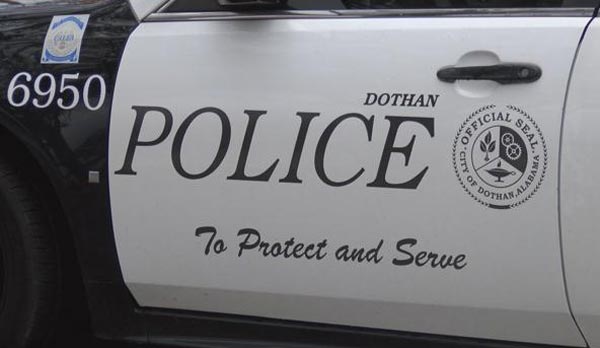
Parrish confirmed the case from the 1990s involving one officer was addressed within the perimeters of the law and the police department policies of that time. According to Parrish, that officer hasn’t worked with the agency since that time.
“His opinion, and that’s all it is his opinion, has been taken by many as facts. It’s a sad day when people read something online, and they take it for fact without any attempt to confirm it,” Parrish said.
The blog post claimed more than a dozen officers were accused of planting evidence on black men in a case in the 1990s. The post included documents that were allegedly from an internal affairs investigation.
“While the photocopies mentioned in the blog that I’m referring to appear to be factual or appear to be authentic for that time period, [the writer] seems to have arranged and redacted those copies in order to meet his agenda,” Parrish said.
Parrish also addressed a photo attached to the blog of him and other officers holding up a confederate flag.
“I’m a history enthusiast. Genealogy is what I’ve studied — my lineage. My ancestors fought for the South in the Civil War,” Parrish said. “I’m proud of that. If that makes me a demon, I’m sorry.” Parrish says around 1999 he thought it would be a novel idea to form a Sons of Confederate Veterans chapter in Henry County.
The police chief says he welcomes the U.S. Department of Justice, the U.S. Attorney’s Office, the Alabama Attorney General’s Office or any other agency to investigate the allegations further.
–WSFA
###
VIRGINIA: Confederate Flag Stirs Protest Ahead of Christmas Parade
ROANOKE, Va. — Dan Smith wants people to protest the display of Confederate battle flags during the annual The Roanoke Times Dickens of a Christmas parade by turning their backs Friday night if a Sons of Confederate Veterans contingent passes by with the flags.
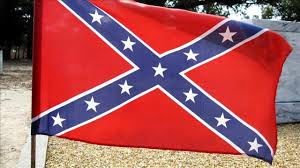
Smith said this week that the parade is not a political event but is meant, instead, to celebrate the birthday of a peacemaker.
“My issue is with the conscious parading of a flag that causes pain to a large segment of our population, all in order to celebrate a war that ended in 1865,” Smith said.
During a news conference Saturday, Brenda Hale, president of the Roanoke chapter of the National Association for the Advancement of Colored People, said the Confederate battle flag is a hateful reminder of slavery, lynching and the violent oppression of African-Americans, especially in the South.
Hale emphatically called on city officials to ban the flag from the parade. But she did not support the act of protest suggested by Smith.
“We don’t have a history of turning our backs on anyone,” she said.
Hale said she has no problem with the Sons of Confederate Veterans. It’s the public display of the battle flag that provokes strong feelings, she said, adding that such display in a Christmas parade seems deeply inconsiderate.
The news conference followed a luncheon meeting of the Roanoke NAACP that was attended by Roanoke Mayor David Bowers and three fellow members of Roanoke City Council — Anita Price, Bill Bestpitch and Sherman Lea.
Afterward, Lea agreed that the Confederate battle flag is a divisive symbol. But he said the council believes it cannot legally ban the flag from the parade because of constitutional protections of free speech.
“We have to respect the rule of law,” Lea said.
The Dickens of a Christmas parade is managed for the city by Downtown Roanoke Inc. Jaime Clark, DRI’s marketing and communications specialist, said the public parade is open to all entrants. DRI anticipates having about 100 entrants in Friday’s parade.
“We acknowledge there are factions that would like us to include some groups and exclude others,” Clark said, echoing a DRI statement issued this summer.
“We have consulted with legal counsel and met with a variety of business leaders and citizens on this issue. It continues to be DRI’s position that the fair and legally responsible thing is to welcome all entrants to safely and peacefully participate in this event,” he said.
Mark Craig, commander of the Sons of Confederate Veterans 28th Virginia Infantry Camp, said the national organization has tangled in years past with the Ku Klux Klan and other groups that have appropriated the Confederate battle flag as a symbol of hate.
He said the battle flag should not be associated with a defense of slavery and cited the circumstances of an ancestor he said fought for the Confederacy.
“My great-grandfather was a poor dirt farmer in Bedford County who never owned slaves,” Craig said.
He said the 28th Virginia Infantry camp he commands has about 30 members. He anticipates that 12 to 20 members will march in Friday’s parade and that his camp typically participates in annual parades for St. Patrick’s Day and Veterans Day.
Hale said Saturday that if the group would be willing to march Friday without displaying the Confederate battle flag, which tends to be the most provocative of the Confederacy’s flags, she would consider that a reasonable compromise.
Five years ago, Camp 1296 of the Stonewall Brigade of the Sons of Confederate Veterans, which has battled Lexington officials for years about displays of Confederate flags from public light poles on Lee-Jackson Day, offered not to fly the Confederate battle flag as a gesture of good will.
Instead, the group agreed to fly the Second National Confederate Flag, Lee’s headquarters flag and a period state flag.
Craig said Saturday that he doubted members of his camp would agree to forego flying the battle flag.
“To me, that’s not a compromise,” Craig said. “It feels like giving up something. Why should we give it up? Everybody else can have their culture.”
He scoffed at the idea that the battle flag could provoke anger or anguish.
“If it causes them pain, they are ignorant about the flag,” Craig said.
He said the media has turned people against the Confederate battle flag in the wake of the June 17 shooting in Charleston, South Carolina, that killed nine people during a prayer meeting at an historic African-American church.
The alleged shooter, Dylann Roof, had posed with a Confederate battle flag and symbols associated with white supremacist groups in photographs discovered after the shooting. Craig said Roof was not a member of the Sons of Confederate Veterans.
“We are not racists,” he said, noting that members of the Sons of Confederate Veterans honor Southern heritage. “We’re not trying to be hard to get along with.”
–Roanoke.com
###
ARKANSAS: Two Civil War Battlefields Slated for Grant Match
Two Civil War battlefields in Arkansas are among 10 selected by the Civil War Trust that will have individual donations for land preservation matched 10-to-1 for the remainder of December, the national nonprofit announced.
The preservation effort includes saving 448 acres at the Elkins’ Ferry Battlefield, north of Prescott in Nevada County, and 40 acres at Prairie Grove Battlefield in Washington County. The two sites account for about 41 percent of the 1,180 acres in seven states that the Civil War Trust fundraiser is targeting for preservation.
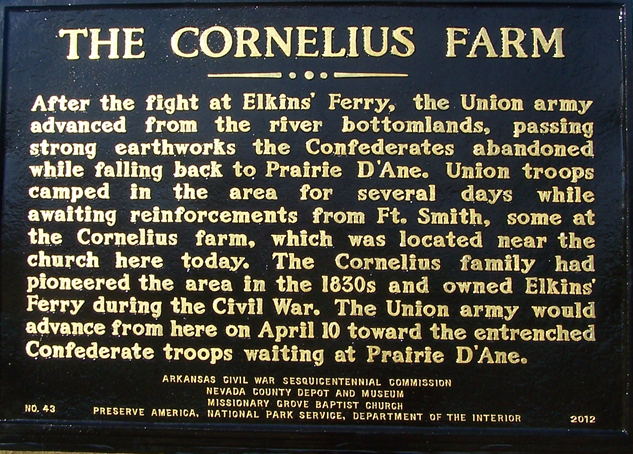
Engagement at Elkins’ Ferry/The Cornelius Farm
The Engagement at Elkins’ Ferry on April 3-4, 1864, was part of the Camden Expedition, the Arkansas portion of the Red River Campaign. Confederate forces led by Brig. Gens. John Marmaduke and Joseph Shelby attacked a Union column commanded by Maj. Gen. Frederick Steele that was intending to cross the Little Missouri River in southwest Arkansas. There were 92 casualties in the battle, a Union victory, according to the Encyclopedia of Arkansas online site at encyclopediaofarkansas.net.
The Battle of Prairie Grove on Dec. 7, 1862, was the last major engagement in Northwest Arkansas and resulted in ending any major presence of the Confederate Army in that region of the state and in Missouri for the remainder of the war. The Confederates, under Maj. Gen. Thomas Hindman’s command, suffered 204 killed, 872 wounded and 407 missing. Union forces reported 175 killed, 808 wounded and 250 missing, according to the online Encyclopedia of Arkansas.
“The Elkins’ Ferry purchase of 448 acres is huge,” said Mark Christ, spokesman for the Arkansas Historic Preservation Program. “It covers the majority of land where the fighting took place on April 4 of 1864. The property will be owned by the Nevada County Depot and Museum. They will work with local and state partners to develop it as a heritage and tourism site.”
Though different accounts of the engagement spell the battleground name as Elkin’s or Elkins, including variations in the battlefield description on the Trust’s website and on the Elkins’ Ferry Battlefield Preservation group’s website at saveelkinsferry.com, the preferred spelling is Elkins’ Ferry, Christ said.
The Prairie Grove property also is significant, he said.
“It includes land where [Brig.] Gen. James Blunt’s Union brigade of the Army of the Frontier made an attack on the Confederate left on Dec. 7, 1862, that resulted in the battle coming to a bloody standstill as darkness fell. Then the Confederates retreated that night because they were out of ammunition,” he said.
Meg Martin, communications manager with the Civil War Trust, said the 40 acres for the Prairie Grove Battlefield will become part of Prairie Grove Battlefield State Park, an addition to the 270 acres the Trust had previously saved at that battlefield. The property at Elkins’ Ferry is the first land the Trust has ever saved at that site.
“These successes will bring the total battlefield land saved by the Trust in Arkansas to over 800 acres,” Martin said in an email Friday.
Other battlefield acreage that the Civil War Trust wants to preserve include sites in Virginia, North Carolina, Tennessee, Maryland, Oklahoma and Colorado. Combined, the 10 battles in those locations accounted for more than 43,000 casualties, according to the Trust.
The sites at Honey Springs, Okla., and Sand Creek, Colo., along with the two Arkansas battlefields, were part of the Trans-Mississippi Theater west of the Mississippi River.
“It is really quite noteworthy that this fundraising campaign includes four of the Trans-Mississippi battlefields, including the two in Arkansas,” Christ said. “Both battles at Honey Springs and Sand Creek involved Native Americans.”
The fundraising drive will match every $1 donated with $10.10 through the end of December, according to the Civil War Trust announcement. Tax-deductible donations can be made through the Trust’s website at civilwar.org, which also has more information on each of the 10 battlefields.
Outside of the matching program, checks also can be sent to the Trust, restricting a donation to a specific battlefield, Martin said.
###