TEXAS: Restoring fading, damaged Texas historical markers becomes man’s mission
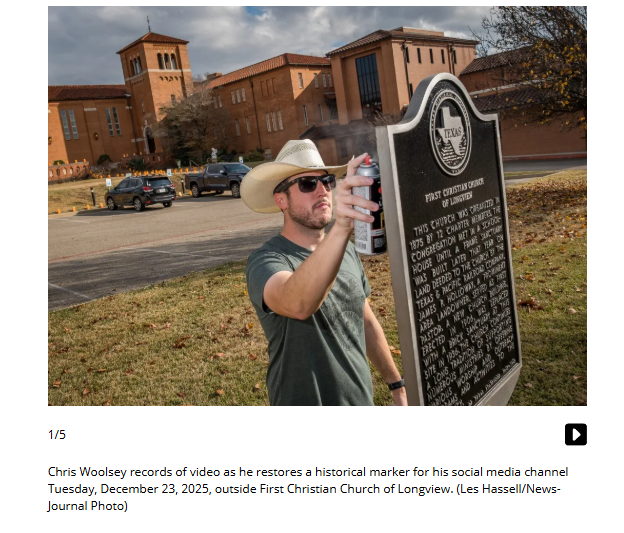
What started as childhood resentment for his dad’s mandatory roadside history stops on family vacations has evolved into a full-blown passion for Chris Woolsey. Woolsey is now on a heartfelt mission to breathe new life into Texas’ fading historical markers. On a mild Tuesday afternoon just before Christmas, Woolsey set up his camera and tripod near a weather-worn historical marker outside First Christian Church in Longview. Sandpaper in hand, he began transforming the sun-faded marker back to its past glory.
“So each marker takes like 30 minutes to an hour,” Woolsey said. “You know, I try to gauge about an hour for each one.” The restoration itself is methodical: sanding, repainting, touching up letters dulled by sun and rain. But Woolsey’s process always extends beyond the marker. He circles the site, filming details, absorbing context and preparing to tell the story online under his social media handle @ChrisRestores. “You factor in like the walking around and getting video of stuff and trying to create a scene for it,” he said.
The goal is never just the plaque – it’s helping people understand where they are and why it matters.
Woolsey’s wife, Allyson, a Longview High School alum, grew up here, and her parents still attend First Christian, making this restoration feel personal. The 1995 plaque – marking the church’s humble 1875 beginnings with just 12 charter members meeting in a schoolhouse before building on land donated by the Texas & Pacific Railroad – stands as a quiet testament to First Christian’s community roots. It’s not just another roadside stop. It’s family, faith and Texas history converging on one quiet corner.
Woolsey’s instinct to stop and pay attention traces back to his childhood in the North Dallas suburbs. “My dad always made the whole family stop on road trips. We would stop for scenic views and historical markers,” he said. “You know, I hated it when I was little. Now I love it.” Years later, that lesson resurfaced when Woolsey struggled to locate a historical marker in Dallas only to discover it had snapped off its post. Research led him to the Texas Historical Commission’s volunteer guidelines and eventually to the realization that he could do something about it himself.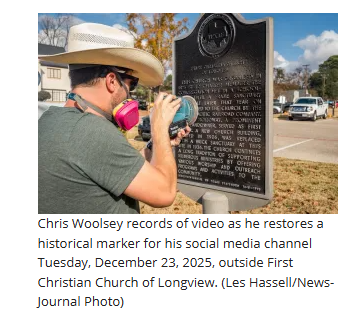
“I ‘next weekended’ it for about six years,” he said, before finally restoring his first marker this past summer. That decision coincided with a larger life shift.
“I just finally couldn’t do it anymore,” Woolsey said of leaving corporate America, where his role had drifted away from people and into analytics. With Allison’s support, he began working for himself doing contract work when he’s not restoring markers across the state.
“I’m painting and outdoors, working with my hands,” Woolsey said. “That’s what I really like to do – that and talking to people. It’s fun, and I’m certainly not short on words, ever.”
Since then, he’s restored more than 150 markers (out of more than 18,000 statewide), traveling everywhere from Nacogdoches and Texas City to the wide-open spaces of West Texas. Those markers bear the scars of time and misuse. Weather does the most damage, but Woolsey regularly encounters vandalism.
“Bullet holes are far more common than you might think,” he said, especially in rural areas. Others suffer from thrown objects that damage the raised letters or poor placement that allows water to pool and accelerate decay.
“(The First Christian) marker was placed in 1995, but I’ve seen some that were placed in 2005 that were way worse, and they shouldn’t be,” Woolsey said.
Woolsey adapts as he goes, carrying metallic paint pens to fill pitted lettering and taking care to preserve as much of the original marker as possible. Every restoration brings a history lesson, and some linger longer than others.
“I’ve learned more than you might believe,” he said, pointing to the New London school explosion and the Texas City disaster as stories that sent him deep into research rabbit holes. Others are stranger, like the marker for the C.W. Post Rain Battles, in which dynamite was used in an attempt to make it rain and end a drought.
“It’s all kinds of weird stories,” Woolsey said of the ones that intrigue him the most – the kind of intrigue that rarely surfaces until someone stops to read the marker. Community response has been overwhelmingly positive, with towns such as Mason inviting him via its chamber of commerce and local residents thrilled to see their pride restored.
Sure, he gets ribbed for mispronouncing places such as Llano or Gruene, but the real reward for Woolsey is inspiring others. He dreams of expanding to untold small-town tales beyond markers and, ideally, supporting his family while encouraging everyone to slow down, pull over and engage with local history. Woolsey isn’t just restoring metal; he’s reinforcing community memory – sometimes in places tied directly to his own family, such as First Christian.
“Everybody’s in such a hurry,” Woolsey said. “Nobody pulls over for these things anymore.” His work, whether in a remote West Texas town or outside his in-laws’ church at Christmastime, is a quiet invitation to slow down, look closer and remember how the story got here.
–tylerpaper.com