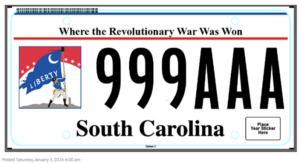
SOUTH CAROLINA: Charleston Honors Civil War Memorial Day Tradition
CHARLESTON, SC — The recently state-sanctioned Confederate Memorial Day holiday is past, but Saturday marks a celebration held annually in Charleston since the late 1800s.
Civil War re-enactors will honor fallen Confederates at Magnolia Cemetery, where some 800 soldiers are buried. Five Confederate generals and 14 signers of the Ordinance of Secession rest there.
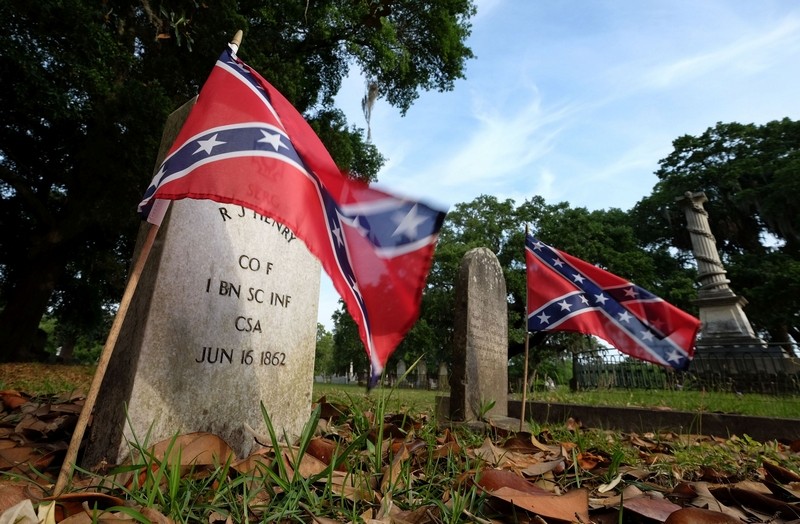
Magnolia cemetery was decorated with flags earlier this week. The traditional national flags that once dotted the Confederate graves are now joined by a more controversial symbol — the battle flag. MATTHEW FORTNER/STAFF
he event is now held on the weekend after the official holiday so that more people can attend. It is co-sponsored by Charleston Chapter #4 United Daughters of the Confederacy and Secession Camp #4 Sons of Confederate Veterans.
he tradition dates to the 19th century and has its origins in the Siege of Charleston, when burials happened by candlelight as the city was bombarded. Women placed First National flags of the Confederacy on each grave.
After Reconstruction, the tradition was revived. May 10 was chosen because it is the anniversary of Confederate Gen. Stonewall Jackson’s death in 1863. The memorial service on the Soldiers Ground in Magnolia has been held every year since 1894.
The cemetery was decorated with flags this week, including Confederate national flags above a monument to the soldiers. But those traditional national symbols that once dotted the graves are now joined by a more recognizable, controversial one — the battle flag.
The Statehouse flag
For more than 50 years, some version of the rebel flag flew over the Statehouse. In 1961, it was raised above the dome to commemorate the Civil War centennial.
In 2000, after a lengthy debate, a compromise was reached to remove the flag from the dome and hoist a smaller version, the S.C. Infantry Battle Flag, on the Confederate Soldier Monument in front of the capitol.
State government was closed again Tuesday for the holiday, a tradition also created during the contentious 2000 legislative session. The S.C. Heritage Act that spawned the official holiday also attempted to preserve Southern history. A two-thirds vote of the Legislature is now required to alter public displays, such as memorials or statues.
Symbols under siege
The push to completely remove the Confederate flag from Statehouse grounds heated up as soon as photos surfaced online showing Dylann Roof — facing nine counts of murder in the June mass shooting at Emanuel AME Church — holding the flag.
Gov. Nikki Haley called for the flag’s removal, which came in July, and plans for how to display it at a museum are still being debated.
Only a handful of Southern states hold annual observances honoring Confederate war dead, most in April and May, according to the U.S. Department of Veterans Affairs. Last year, Georgia removed listings for Confederate Memorial Day and Gen. Robert E. Lee’s birthdays on its official holiday calendar list, renaming both as “state holiday.”
That move came as many states grapple with how to honor what many term their Southern heritage while placating an anti-Confederate movement sweeping the country after the Charleston shootings. Alabama also removed a Confederate battle flag from its Capitol grounds. Other flags and Confederate emblems in such states as Mississippi and Texas were moved or taken down altogether.
–postandcourier.com
###
TEXAS: Battle Sounds: Dramatization to Portray Civil War
TEMPLE, Tx. — If an army marches on its stomach, its heart beats to the cadence of drums and brass. That was certainly true during the War Between the States.
A New York Herald newspaper reporter observed in 1862, “All history proves that music is as indispensable to warfare as money; and money has been called the sinews of war. Music is the soul of Mars….”
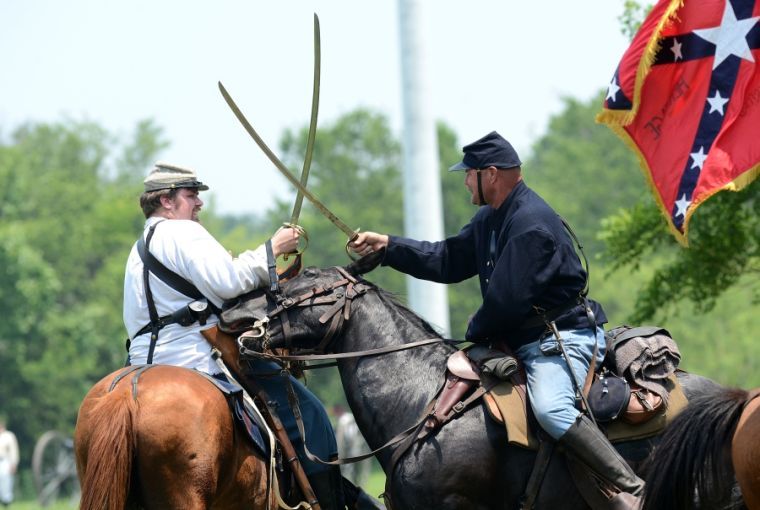
Actors performing as Confederate and Union soldiers sword fight during one of the demonstrations in Temple on Saturday.
So it is with make-believe battles on a Central Texas prairie.
The eighth annual “Battle of Temple Junction” offers reenactments of fictionalized battles and mid-19th century lifestyles. The weekend events bring history to life on the grounds of the Texas Early Day Tractor and Engine Association Show, 1717 Eberhardt Road. Although it never really happened in real life, the “Battle of Temple Junction” illustrates how Union and Confederate troops lived, trained and fought during the Civil War.
New to the “battle” this year is the Heritage Brass Band, a Dallas-based volunteer band directed by Larry Johnson. Dressed in authentic period uniforms, the 18-member band plays music popular in the North and South with original arrangements.
The band’s presence adds authenticity to the “Temple Junction” weekend. Music was essential to battle-weary troops. Music gave soldiers a sense of identity, nationalistic pride and reminders of why they marched into chaos.
Johnson and his Heritage Brass Band compatriots merge their two big loves – music and history. The ensemble has programs suitable for reenactments for Civil War, Indian Wars and World War II. This time, they will don Confederate grays for the weekend, Johnson said.
A former high school band director with degrees in music, Johnson was an Army officer in Vietnam. While stationed at Fort Polk, La., he was fortunate to have as a mentor Gen. Douglas MacArthur’s band director. Johnson left academia and later went to work as supervisor of linen services at Dallas-area hospitals.
“I learned a lot about fabrics,” he said with a laugh. “Those traditional wool uniforms can get pretty hot.” He researched the appropriate uniform styles and opted out for lighter, albeit appropriate-looking materials. He began playing with Dallas-area community bands in 1974. By 1994, he formed the Heritage Bras Band composed of volunteers ranging from physicians, nurses, businessmen and attorneys to music teachers and retired military.
“I thought it needed to be a band who knows what the heck they’re doing. I had met so many different players and veterans; so I jumped at the chance to form a band,” Johnson said. “We started out as a Civil War brass band and then decided to play other historical eras.”
The band’s fame has spread, with concerts and performances throughout Texas during the past 22 years. Much in demand in the Texas area, the band has performed for dances, ceremonies, reenactments, living history demonstrations, funerals, parades and movie premieres.
Johnson has done meticulous research on the appropriate songs and arrangements used by Civil War soldiers of both ideological sides. “We try to recreate authentic sound, even though we can’t get period instruments,” he added.
One big problem is that Civil War musicians had no pitch standards, Johnson said.
“Pitch standards weren’t established until the 1940s,” he said. “Before then, manufacturers tuned their instruments to each other. That meant to stay in tune you’d have to get a band with instruments from one manufacturer. That just wasn’t possible.”
To create a sound as close as possible to the original, musicians use period mouthpieces. Drums are exact reproductions of mid-19th-century military drums. The band has even recorded an album of rarely played Stephen Foster songs.
The band’s library enables it to play authentic music from several different periods. This music collection contains national anthems of more than 90 different nations, all 50 state songs and many historical marches and period pieces, including the surviving music of the 26th North Carolina Infantry band that played at Gettysburg. The repertory likewise is authentic, sidestepping more modern arrangements of later decades and early 1900s.
However, one ever-popular song always excites the crowd.
“We make our living playing ‘Dixie,’” Johnson added.
The Heritage Brass Band joins a hundred or more Civil War re-enactors on the grounds to stage a real-life tableau of historical fiction. Donning period-appropriate gray kepis and scratchy wool uniforms, players stage full-scale fake battles, historically correct encampments, surgical demonstrations and cavalry competitions.
“Temple Junction” is an observance of memory that never was because no Civil War battles ever roiled in Bell County, but the county sent many men and supplies to the fight. Add to that, Temple didn’t exist in 1861.
Which all leads to the musical question: “So what?”
Facts are suspended for the weekend while the actors demonstrate the rigors of military life in the 1800s. Schoolchildren are wide-eyed with curiosity and amazement at how people lived more than 150 years ago.
The event kicks off on Friday with area school districts taking part in living history demonstrations illustrating how soldiers cooked, slept and camped during the Civil War.
On Saturday and Sunday, full-scale battle reenactments feature period and reproduction weapons, military surgical demonstrations and cavalry competitions.
–Temple Daily Telegram
###
ARKANSAS: Final Report of Sesquicentennial Released
The final report for the Arkansas Civil War Sesquicentennial Commission, which completed its task of commemorating the 150th anniversary of the American Civil War on December 31, 2015, is now available on the ACWSC website at https://www.arkansascivilwar150.com/annual-reports. Some highlights:
 The ACWSC sanctioned a total of 732 events attended by at least 375,275 people.
Eighteen museums from around the state reported they sponsored a total of 112 Civil War-related events and/or exhibits between 2011 and 2015 that were attended by 122,566 visitors.
Twenty-eight Arkansas State Parks reported that they sponsored 256 Civil War-related events and/or exhibits attended by103,188 people.
A total of 218 “Arkansas Civil War Road Warriors,” including residents of Maryland, Georgia, Tennessee, Mississippi, Texas, West Virginia, Louisiana, Utah, Kansas, South Carolina and California, completed the ACWSC passport program.
A total of 18 books, 148 journal and newsletter articles, and 317 Encyclopedia of Arkansas History and Culture entries on Civil War-related topics were published between 2011 and 2015.
The ACWSC awarded 85 grants totaling $149,913.
A total of 144 Arkansas Civil War Sesquicentennial Historical Markers were approved, with at least one in each of the state’s 75 counties.
A series of 122 podcasts were recorded by 54 Civil War experts in a partnership of the ACWSC and the College of Mass Communication at the University of Arkansas at Little Rock.
At the Elkins’ Ferry Battlefield in Nevada County, 448 acres were acquired for preservation.
The Arkansas Civil War Sesquicentennial Commission received a Diamond Award, the highest honor given by the Arkansas Historical Association, in 2013. Preserve Arkansas, Arkansas’s non-profit historic preservation advocacy organization, awarded the ACWSC its 2015 Award for Outstanding Achievement in Preservation Education for an Organization. The Commission received the 2016 Arkansas Heritage Award, one of the Henry Awards given by the Arkansas Department of Parks and Tourism.
–arkansaspreservation.com
###