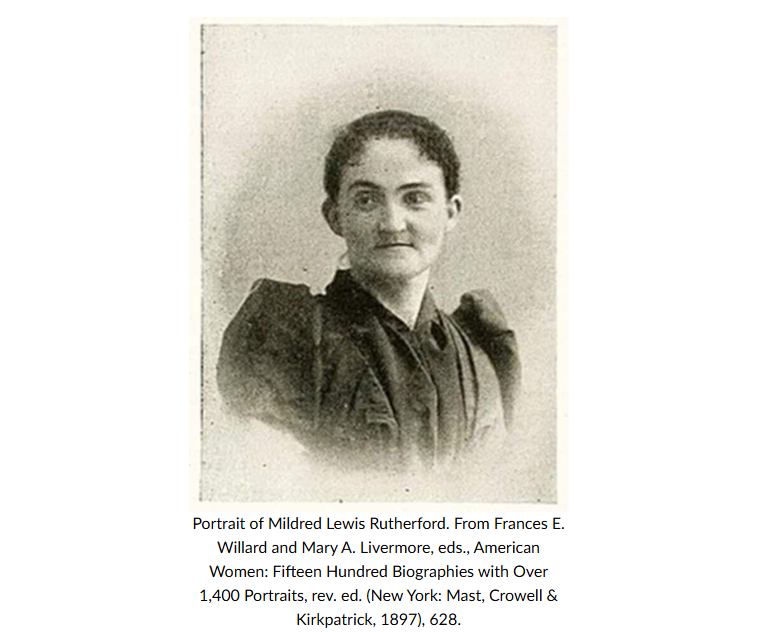
To fully understand the mechanics of female political power in American history, we must also examine the powerful conservative women who marched in exactly the opposite direction from progressive women reformers. This is an under-explored chapter of women’s history that features staunchly conservative, anti-suffrage Southern women who wielded tremendous political and cultural clout. As architects of the Lost Cause, they were highly effective actors who shaped government policy and public memory as forcefully as any man who cast a ballot. They were on the other side of the women’s movement coin. And no one embodies this power more than the educator and Lost Cause activist from Athens, Georgia: Mildred Lewis Rutherford, a.k.a. Miss Millie.
Born into Georgia aristocracy in 1851, Rutherford was a child of wealth and privilege. Her family was well connected with the southern political and academic elite; her uncles included two Confederate generals and a former (U.S.) Speaker of the House. When the Civil War demolished the Old South, Rutherford did not retreat into quiet, impoverished nostalgia — she turned to ideological instruction and shaping the South’s cultural memory of the war.[1]
Crucial to her eventual rise to power, however, and much like other powerful women of her era, Rutherford never married. In 19th-century society, this allowed her to keep legal, financial, and professional independence throughout her life. Spinster status permitted her to freely maneuver in public and political circles in ways a married woman could not.
For over forty years, she focused that independence on serving in various capacities, including president of the Lucy Cobb Institute in Athens. Under her leadership, the school went from a small, failing local academy to the premier finishing school for the daughters of the Southern elite. But Rutherford was not just teaching French and literature to empty-headed debutantes; she was indoctrinating future generations of Southern matriarchs. She used her position to craft a loyal, highly sophisticated network of women who were in step with her version of the Old South, the War Between the States, and the Confederacy.
Rutherford also used her platform to fiercely oppose women’s suffrage, arguing that women did not need the vote. She argued that “feminine influence and persuasion (was) power enough to direct legislative bodies.” Despite living a decidedly non-traditional life as one of Georgia’s most recognized and outspoken women, she stridently contended that southern ladies should stay out of the public eye and fully embrace traditional domestic roles. This was the ultimate paradox of Rutherford’s life, a contradiction that she never acknowledged. [2]
In time, Rutherford’s local renown in Georgia propelled her onto the national stage. From 1911 to 1916, she was the historian general of the United Daughters of the Confederacy (UDC), and she used the Confederate Veteran magazine to get her message out. While she did not edit this widely read periodical, she leveraged its significant reach. Recognizing that the magazine was the center of gravity of the south’s memorial network, Rutherford used UDC’s dedicated section of Confederate Veteran to publish her monthly articles and study guides. By 1916, she had her own byline: the “Historian General’s Page,” and Rutherford used it to ensure that her unreconstructed vision of the Old South was read by the magazine’s 30,000 subscribers.
Rutherford was a key leader in the south’s cultural counter-offensive. In addition to her literary skill, she was a compelling public speaker who traveled the country dressed in her hoop skirts, delivering lectures defending the Southern cause and the truths of the Confederacy. Rutherford was also never averse to bending the truth. In Dallas, Texas, at her farewell address as the UDC’s historian, she delivered a 90-minute history lesson on the Lost Cause stating “…the negroes in the South were never called slaves. That term came (from) the abolition crusade. They were our servants, part of our very home, and always alluded to as the servants of a given plantation.”[3]
Looking back, it is easy to imagine the prim 65-year-old Miss Millie — the picture of lace-collared, matronly charm — delivering this outrageous bit of historical fiction in a warm, perfectly polite Georgia drawl. But beneath the crinoline and lace was a hard-nosed organizational genius and skilled culture warrior who understood a basic truth: Whoever controls the schoolbooks eventually controls the narrative.
Rutherford’s most devastatingly effective contribution to the southern cause was her 1919 manifesto, A Measuring Rod to Test Textbooks, and Reference Books in Schools, Colleges, and Libraries. The purpose of the 24-page pamphlet was to ensure that textbooks adopted for colleges, schools, and other scholastic institutions accord full justice to the South (and) presents the truthful facts of Confederate history.” [4]
The book was a set of general orders for UDC chapters across the South. If a publisher wanted to sell books below the Mason-Dixon line, they had to pass Rutherford’s litmus test. Her ten commandments for acceptable “full justice and truthful facts” were comprehensive and absolute. Here are a few:
- “Reject a book that calls the Confederate soldier a traitor or rebel, and the war a rebellion.” (The acceptable title was the War Between the States).
- “Reject a book that says the South fought to hold her slaves.” (The acceptable cause for the war was States’ Rights).
- “Reject a book that speaks of the slaveholder as cruel and unjust.” (The acceptable portrayal was slavery as a benevolent institution).
- “Reject a book that speaks of the Constitution other than as a compact between sovereign states.” (This laid the legal groundwork for students to believe secession was constitutional).[5]
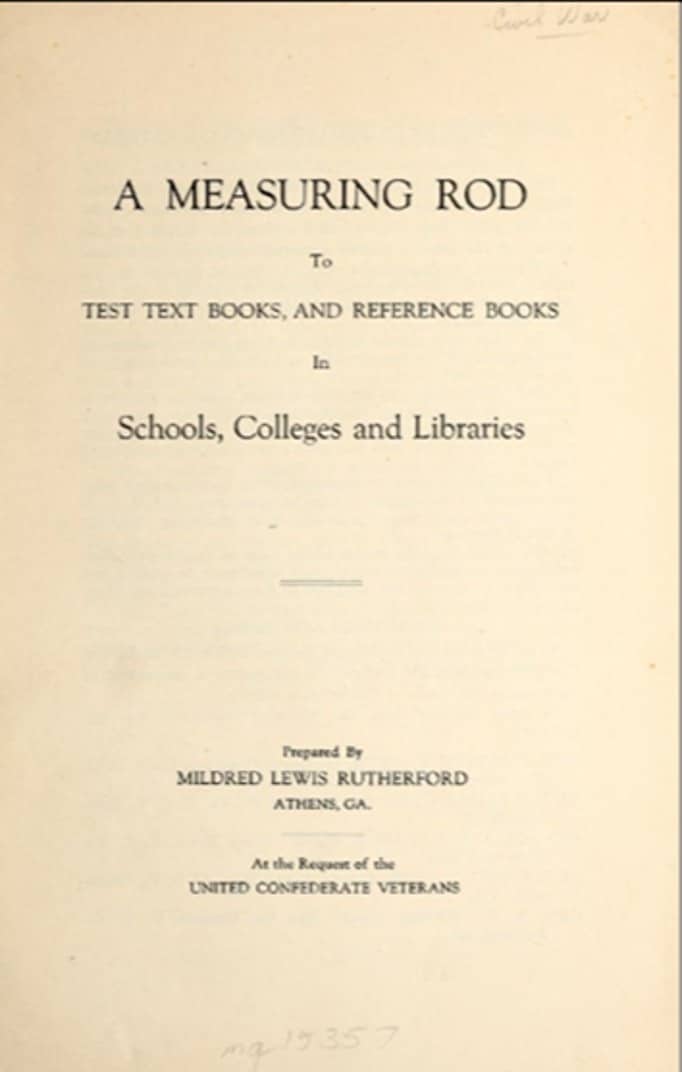
The genius of the Measuring Rod was its utility in the hands of UDC women. Brandishing the little book like a rifle musket, Rutherford expected UDC chapters to march into county school board meetings and demand removal of textbooks that were “Unjust to the South.”[6] Fearing boycotts and the wrath of the UDC, publishers gave in and often printed sanitized “southern editions” just to pass her inspection.
Rutherford spent her life constructing this historical narrative, gathering thousands of documents, letters, and artifacts to support her work. But in a twist of supreme irony, Rutherford’s archives did not survive her. On Christmas night of 1927, a fire destroyed her Athens home. She survived the blaze, but her life work turned to ash. Rutherford died eight months later, in August 1928.
Yet, her cultural and physical footprint outlasted the flames, leading directly to modern battles over historical memory. Today, the University of Georgia houses students in Rutherford Hall. Built as a women’s dorm in 1939, the university demolished the old building in 2012 and built another dorm on the same site and kept the name. Today, it remains the center of controversy, as some students and faculty wage campaigns to remove the name of the South’s premier propagandist from their campus.
Rutherford reminds us that female power in American history has not always been a tool for righteous causes and progressive ideas. Sometimes, it has been a brilliantly organized, tastefully dressed engine of white supremacy disguised as historical “truth” and sold so effectively that generations, North and South alike, believed it – the other side of the women’s power coin. Rutherford’s culture warriors did not want equal rights or the vote; they had all the rights they needed to advance their agenda and were perfectly secure in their role as powerbrokers atop the social hierarchy. Acknowledging the effectiveness of women like Miss Millie is essential to understanding the often-complicated arc of women’s history.
Mark Harnitchek is a retired military officer and currently a student in George Mason University’s History Ph.D. Program.
Endnotes:
[1] One of Rutherford’s uncles was Howell Cobb, former Speaker of the House, Governor of Georgia, and Secretary of the Treasury. He commanded a brigade in the ANV and Georgia reserves in the Western Theater. Thomas Reed Rootes (T.R.R.) Cobb famously commanded Cobb’s Legion. T.R.R. was killed at Fredericksburg. In popular culture, Cobbs Legion was Ashely Wilkes’ unit in Margaret Mitchell’s Gone with the Wind.
[2] Sarah Case, “The Historical Ideology of Mildred Lewis Rutherford: A Confederate Historian’s New South Creed,” The Journal of Southern History, Aug. 2002, Vol. 68, No. 3, 614.
[3] Mildred Lewis Rutherford, The Civilization of the Old South: What Made It, What Destroyed It, What Has Replaced It (Athens: United Daughters of the Confederacy, 1916), 6.
[4] Mildred Lewis Rutherford, A Measuring Rod to Test Text Books, and Reference Books in Schools, Colleges, and Libraries (Athens: United Confederate Veterans, 1919), 2-3.
[5] Ibid, 5.
[6] Ibid, 3.